Skip to content

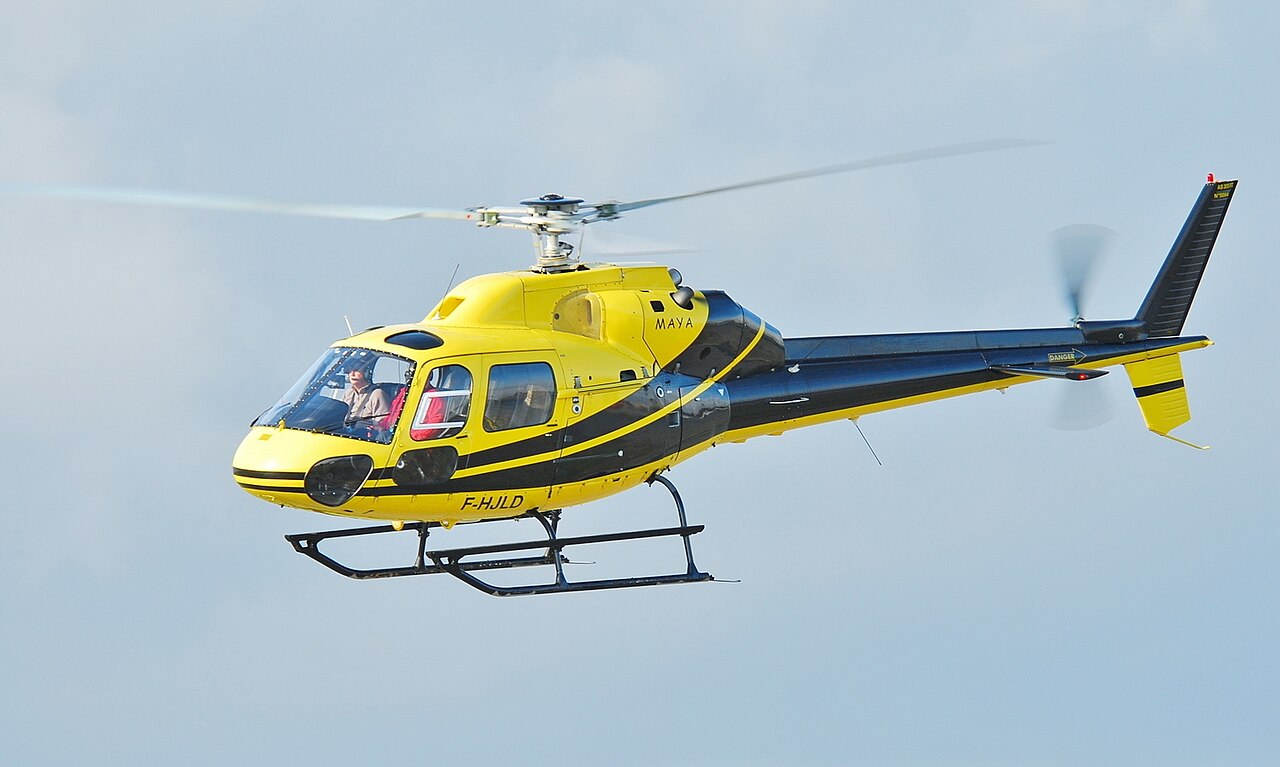
The Airbus AS355 Twin Squirrel is a medium turbine helicopter produced between 1981 and 2008. Price: the Airbus AS355 Twin Squirrel is out of production and, used, the market median is around US$ 800,000. Median from Jet Tracker's price research as of 06/2026. It has a range of 358 nm, a cruise speed of 121 kt (224 km/h), up to 6 passengers. In Brazil there are 11 active units in the RAB-ANAC, excluding cancelled registrations. There are 11 aircraft from this family for sale today, across 11 listings on the portals Jet Tracker tracks (global market, not Brazil only).

Source: RAB-ANAC (data as of 11/12/2026) and Jet Tracker catalog (spec sheet reviewed on 10/30/2026).

Acquisition price · pre-owned market
limited data11 active listings (global)Jet Tracker curation · 8 sources · 6/4/2026
US$ 800.0KR$ 4.5M
market medianaging ≈ −4.6%/yr−77% vs Medium Turbine Helicopter median
Entry
US$ 410.0K
model year 1982
Best value
US$ 700.0K
model year 1990
Top of range
US$ 1.4M
model year 2008
Basis
Listings
real listings
Minimum
US$ 395.0K
R$ 2.2M
Median
US$ 800.0K
R$ 4.5M
Maximum
US$ 1.5M
R$ 8.4M
Depreciation curve by year of manufacture
CAGR +4.8%/yr·1982→2008
Market median by vintage (USD). Light-blue band = min/max range observed across real listings. Points without reliable public listings (n ≤ 1) use Bluebook/curve interpolation and are flagged as lower confidence.
3 of 5 points with reduced confidence (n ≤ 1 listing observed). The estimate for these years comes from Aircraft Bluebook / market-curve interpolation, not from direct listings.
Landed in Brazil

Index ≈ ×1.20 to ×1.47 on the aircraft value, already with ferry, ANAC nationalization, IPI and ICMS.

Through a qualified importer
US$ 474.2K – 1.9M
R$ 2.7M – 10.7M · Agreement 75/91 · IPI + ICMS ~7 to 12%
Direct import
US$ 541.8K – 2.2M
R$ 3.0M – 12.4M · IPI + full ICMS ~25 to 32%

Market estimate: value + ferry + ANAC nationalization + taxes, no legal review. II, PIS and COFINS are 0% for aircraft (NCM 88.02); IPI is 6.5% (3.25% for air taxi) until Dec 31, 2026; ~4% ICMS only through a qualified importer (Agreement 75/91).

Cost per flight hour
Operate · owned
US$ 1.8K/h
R$ 9.9K/h · Variable/h
Fixed/yr
US$ 368.1K
Total/h @ 200 hrs/yr
US$ 3.6K/h
Charter · 🌎 World
US$ 1.6K – 2.2K/h
R$ 9.3K – 12.3K/h

Operate = direct cost/hour (fuel + maintenance + engine); excludes fixed costs (hangar, crew, insurance). World: hourly rate published by charter operators.

How we read this price · 8 sources · researched 6/4/2026

Median and price range for pre-owned aircraft, compiled by Jet Tracker from asking prices in listings and the price guides in the sources below, checked on 6/4/2026. 5 of 5 model years have an observed listing. The rest are estimates from the market curve between model years and are flagged in the chart.

PTAX · R$ 5.6075 / US$ · 11/12/2026

Market estimates for guidance only, not a firm quote. Confirm the value with a broker/appraiser before any transaction.

Temporal identity

First flight
Sep 28, 1979
FAA cert.
—
ANAC cert.
—
Deliveries start
—
Units produced
—

The AS355 Twin Squirrel, known in Brazil as the twin-engine Esquilo, is a light two-engine helicopter built between 1981 and 2008 by the lineage that now belongs to Airbus Helicopters. It has 358 nm of range, a cruise speed of 121 kt and a ceiling of 13,125 ft, with a maximum takeoff weight of 2,540 kg. The cabin seats 5 occupants in the typical configuration and reaches 6 seats. Out of production, it circulates in the used market and remains present in the Brazilian fleet, in business transport and urban operations. Here you will find the spec sheet, the estimated operating cost and the fleet registered in the country.

Detailed specs

Performance

Engines
2x Turbomeca Arrius 1A1 (AS355 N/NP variant) or 2x Allison 250-C20F (early variants)
Engine type
Twin-turbine 357 shp each (Arrius) / 425 shp each (Allison)
Max speed
145 kt
Endurance
3 h
Fuel
730 L
Fuel
192.8 gal
Rate of climb
1,830 ft/min
Service ceiling
14,990 ft
Hover ceiling (IGE)
8,500 ft
Hover ceiling (OGE)
5,400 ft
Main rotor diameter
10.69 m

Cabin and comfort

Doors
4 doors + optional sliding rear door
Seats
6
Optional air conditioning
Yes
Configuration
6 seats (1+5), same cabin as the AS350 with slight weight difference
Typical configuration
Crew 1 + 5 Pax
Useful load
1,218 kg
Noise attenuation
Standard AS355, no Fenestron
Baggage compartment
35 cu ft

Avionics and engines

Cockpit
Analog steam gauges + partial VEMD (later variants)
Autopilot
Optional 2-axis autopilot
Transponder
Garmin GTX 345 with ADS-B Out (mandatory retrofit)
GPS (retrofit)
Garmin GTN 750/650, common retrofit
IFR certified
IFR-certified (single-pilot), differentiator vs. AS350

Operating costs

Data source
Conklin & de Decker, AS355F2 Twinstar Operating Costs & Specs (variable ~$840/h; fuel $320/h @ $5.50/gal; labor $94/h) · Aircraft Cost Calculator, Eurocopter AS355F2 (variable $376,673/yr, fixed $494,698/yr, $2,905/h @ 300h, $7/gal) · Aircraft Cost Calculator, Eurocopter AS355N ($3,093/h @ 300h, $6/gal) and AS355NP ($2,891/h @ 300h) · AS355N fuel burn ~230 L/hr sea level (~60.7 gph), Helimo / operator data · Rolls-Royce M250 / Allison 250-C20F, TBO 3,500 h (Series 2)
Fuel burn
60 gal/h
Last updated
2026
Rotor overhaul interval
4,000 h
Market price (low)
US$ 750,000
Engine overhaul interval
4,000 h
Market price (high)
US$ 2,200,000

External dimensions

Overall length
12.94 m
Wingspan
10.69 m
Height
3.14 m

Weights & fuel

Operating empty weight (OEW)
1,305 kg
Maximum takeoff weight (MTOW)
2,540 kg
Fuel capacity
730 L
Fuel capacity
1,307 lb

Cabin

Standard configuration
1 zone5 typical passengers · 6 max1 crew5 passengers

Typical factory configuration (curated data). The drawing below is schematic and at approximate scale; the actual layout varies by interior and year.

Cabin to scale: cross-section and profile
1,25 m1,62 m
front cross-section · person = 1.75 m
2,35 m long
Length
2.35 m
Width
1.62 m
Height
1.25 m
Volume
—
Baggage
—

History

  1. 1979 - Launched in 1979 as a twin-engine for markets that require redundancy

    Aérospatiale launched the AS355 Écureuil 2 ('Twin Squirrel') in 1979 as the twin evolution of the AS350, a direct derivative with identical cabin and dynamics, but with 2 Allison 250-C20F engines. It was a response to the requirements of operators who needed engine redundancy for night EMS, IFR executive and offshore missions: American and European regulations restricted single-engine in some operations. Variants evolved: F (250-C20F), N (Arrius 1A), NP (Arrius 1A1, 3-blade main rotor).

  2. 1979First flight
  3. 2008 - Replaced by the EC135/H135 starting in 2000

    Airbus Helicopters announced in 2015 the end of AS355 production, gradually replaced by the EC135 (1996+, later H135 in 2014), which offered twin-engine, IFR, more cabin and more modern technology. The AS355 was 'an AS350 with one more engine', while the EC135 was a totally new platform with a rigid rotor (Bo 105 heritage) and Fenestron. More than 700 AS355s produced vs. 1,300+ EC135/H135. Active global AS355 fleet ~400 units, with Airbus support guaranteed until the end of this decade.

    Airbus Helicopters
  4. 2008End of production

Brazil Fleet

Lineage

Model with no documented lineage in the manufacturer's line.

Curiosities and highlights

Benefits

Twin-engine + IFR enables night EMS and corporate IFR operations

The main differentiator vs. the AS350 is twin-engine capability + single-pilot IFR certification. It enables operations that single-engine cannot serve: night IFR EMS (Polícia Civil RJ, ANJOS RS), corporate VIP transport in IFR/IMC, urban police in marginal weather and early offshore (before the H225/AW139 era). Operating cost of ~USD 1,100/h is 30%+ above the AS350, but justified by mission profile niches that a single cannot serve.

Pre-owned acquisition cost between USD 750k-2.2M attracts low-cost twin operators

The pre-owned AS355 market (end of production announced in 2015) has prices between USD 750k-2.2M depending on variant, hours and configuration, a fraction of the price of an equivalent modern twin (H135 USD 4.5M+, AW109 USD 6M+). For operators who need an IFR-capable twin-engine but cannot invest in a new twin, the AS355 offers an affordable entry. Trade-offs: more expensive parts (discontinued), specialized MRO and limited hot/high performance.

Limitations

Hot/high performance inferior to the AS350, 2 engines add weight

Despite being twin-engine, the AS355's total power (2x 357-425 shp = 714-850 shp) is equivalent to or slightly higher than the single-engine AS350 B3 (847 shp), but with an additional 162 kg of empty weight (2 engines, gearboxes, duplicated fuel system). Result: OGE hover of 5,400 ft (vs. 11,880 ft for the single-engine B3), disappointing hot/high performance. The AS355 only pays off in IFR/twin-required missions, not at altitude.

Curiosities

Helibras produced the HB355 Esquilo Bimotor in Itajubá

Helibras produced the HB355 ('Esquilo Bimotor') under Aérospatiale/Eurocopter license in Itajubá MG between 1981-2007, the Brazilian version of the AS355. The historical Brazilian fleet exceeded 80 units in simultaneous operation, present in the PRF (Federal Highway Police), Federal Police, Military Police of SP/RJ/MG and executive operators. Globo's SP ENG operation had AS355 units in the 90s (replaced by AS350/H125). In 2024 the active Brazilian fleet still exceeds 50 units, with Helibras support guaranteed.

Helibras

Catalogued accidents

Sources: NTSB, CENIPA, Aviation Safety Network

5/29/2015· BR· ATALAIA DO NORTE
PR-ADA
Fatal · 5

In-flight collision with obstacle

4/26/2014· BR· OROCÓ
PR-HFC
Serious

Loss of control in flight

1/26/2013· BR· IPIXUNA
PR-HBE
Serious

In-flight fire

10/18/2011· BR· ITACOATIARA
PR-HBC
Serious

Loss of component in flight

4/6/2011· BR· ALTO ALEGRE
PT-HNA
Fatal · 3

Loss of control in flight

2/2/2008· BR· CAAPIRANGA
PT-HNH
Serious

In-flight fire

Registrations in Brazil

8 operational aircraft owned by companies in the ANAC registry (RAB). Each opens the profile with owner, operator, status and history.

PP-ESSPP-SESPR-HFDPR-HTLPR-RJJPR-YTTPS-RDAPS-YTT

Frequently asked questions

How much does the Airbus AS355 Twin Squirrel cost?

The Airbus AS355 Twin Squirrel is out of production, so there is no factory price. On the used market the median is around US$ 800,000, varying with year and flight hours; see real listings on this model's Market tab. Reference value as of 06/2026.

What is the range of the Airbus AS355 Twin Squirrel?

The maximum range is 358 nm (358 NM · 663 km).

How fast is the Airbus AS355 Twin Squirrel?

Cruise speed is 121 kt, equivalent to 224 km/h.

How many passengers does the Airbus AS355 Twin Squirrel seat?

The Airbus AS355 Twin Squirrel seats up to 6 passengers, crew not included.

How many Airbus AS355 Twin Squirrel are there in Brazil?

There are 11 active units in the RAB-ANAC (data as of 11/12/2026): operational, mark reservation or suspended, excluding cancelled registrations.

Who operates the Airbus AS355 Twin Squirrel in Brazil?

6 distinct operators operate 10 units of the Airbus AS355 Twin Squirrel in the RAB-ANAC: 6 in air taxi (RBAC 135) and 4 in private operation (RBAC 91), concentrated in RJ, SP and BA (data as of 11/12/2026). Not included in that count: 1 unit run by a public body (police, fire department or government). Name, fleet and state of each operator are on this model's Analytics tab and in the operators directory.

How much does it cost to operate the Airbus AS355 Twin Squirrel per hour?

Jet Tracker estimate: about US$ 3,604 per flight hour at 200 h/year, of which US$ 1,764 per hour is variable cost (fuel, engine program, maintenance reserves) plus US$ 368,100 per year of fixed cost (crew, hangar, insurance), under Jet Tracker's default assumptions (Southeast Brazil, in-house crew, 200 h/year). Run your own scenario on this model's Costs tab.