Skip to content

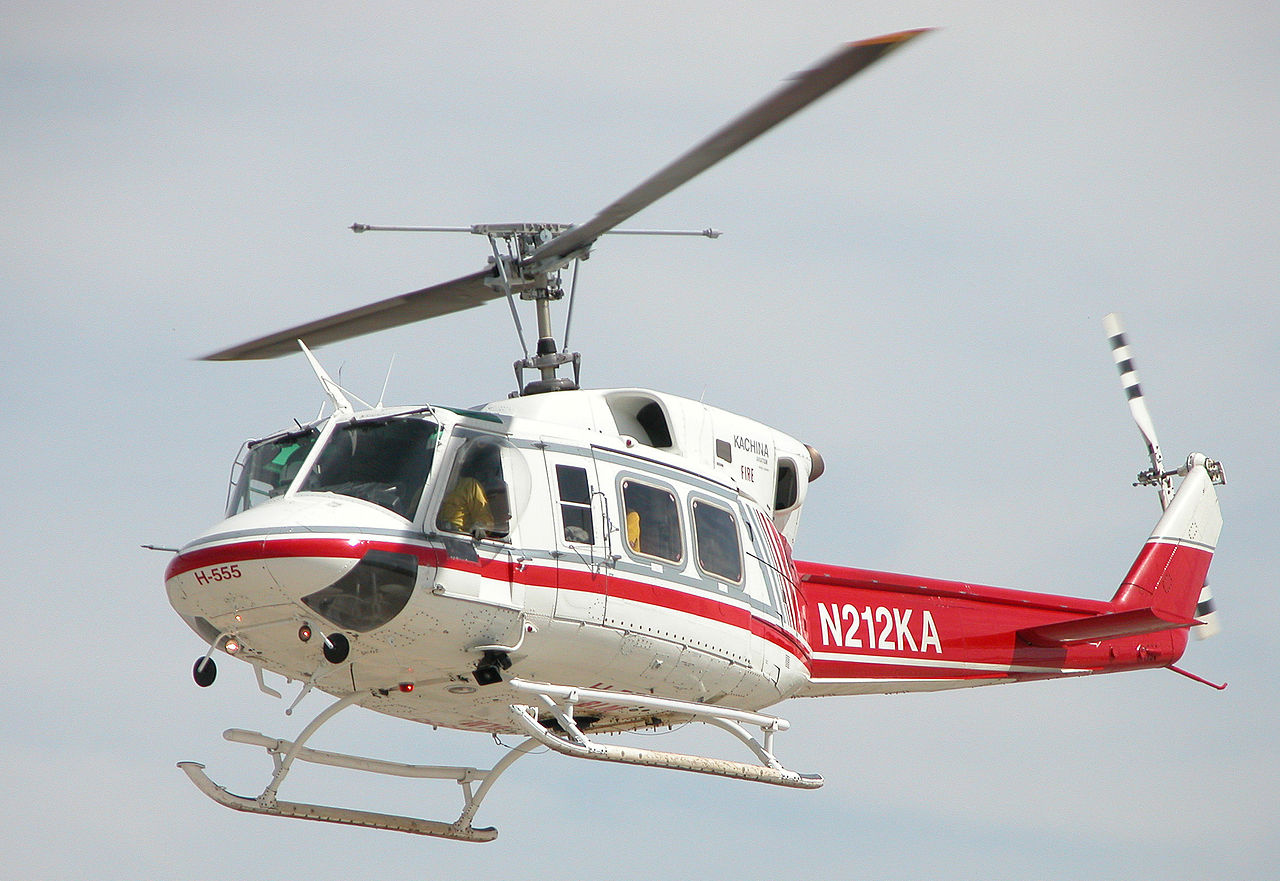
The Bell 212 is a medium turbine helicopter produced between 1968 and 1998. Price: the Bell 212 is out of production and, used, the market median is around US$ 2.0M. Median from Jet Tracker's price research as of 06/2026. It has a range of 250 nm, a cruise speed of 100 kt (185 km/h), up to 14 passengers. In Brazil there is 1 active unit in the RAB-ANAC, excluding cancelled registrations. There are 7 aircraft from this family for sale today, across 8 listings on the portals Jet Tracker tracks (global market, not Brazil only).

Source: RAB-ANAC (data as of 11/9/2026) and Jet Tracker catalog (spec sheet reviewed on 11/9/2026).

Acquisition price · pre-owned market
limited data8 active listings (global)Jet Tracker curation · 4 sources · 6/4/2026
US$ 2.0MR$ 11.0M
market medianaging ≈ −2.5%/yr−43% vs Medium Turbine Helicopter median
Entry
US$ 1.8M
model year 1971
Best value
US$ 1.9M
model year 1981
Top of range
US$ 3.5M
model year 1998
Basis
Listings
real listings
Minimum
US$ 1.8M
R$ 9.6M
Median
US$ 2.0M
R$ 11.0M
Maximum
US$ 3.5M
R$ 19.3M
Depreciation curve by year of manufacture
CAGR +2.6%/yr·1971→1998
Market median by vintage (USD). Light-blue band = min/max range observed across real listings. Points without reliable public listings (n ≤ 1) use Bluebook/curve interpolation and are flagged as lower confidence.
3 of 4 points with reduced confidence (n ≤ 1 listing observed). The estimate for these years comes from Aircraft Bluebook / market-curve interpolation, not from direct listings.
Landed in Brazil

Index ≈ ×1.10 to ×1.38 on the aircraft value, already with ferry, ANAC nationalization, IPI and ICMS.

Through a qualified importer
US$ 1.9M – 4.1M
R$ 10.6M – 22.8M · Agreement 75/91 · IPI + ICMS ~7 to 12%
Direct import
US$ 2.2M – 4.8M
R$ 12.3M – 26.6M · IPI + full ICMS ~25 to 32%

Market estimate: value + ferry + ANAC nationalization + taxes, no legal review. II, PIS and COFINS are 0% for aircraft (NCM 88.02); IPI is 6.5% (3.25% for air taxi) until Dec 31, 2026; ~4% ICMS only through a qualified importer (Agreement 75/91).

Cost per flight hour
Operate · owned
US$ 2.1K/h
R$ 11.4K/h · Variable/h
Fixed/yr
US$ 337.0K
Total/h @ 200 hrs/yr
US$ 3.7K/h
Charter · 🌎 World
US$ 2.5K – 3.0K/h
R$ 13.8K – 16.5K/h
Charter · 🇧🇷 Brazil
US$ 2.5K – 4.0K/h
R$ 13.8K – 22.1K/h

Operate = direct cost/hour (fuel + maintenance + engine); excludes fixed costs (hangar, crew, insurance). World: hourly rate published by charter operators. Brazil: charter is quoted per leg, so the hourly figure is an estimate from route quotes.

How we read this price · 4 sources · researched 6/4/2026

Median and price range for pre-owned aircraft, compiled by Jet Tracker from asking prices in listings and the price guides in the sources below, checked on 6/4/2026. 2 of 4 model years have an observed listing. The rest are estimates from the market curve between model years and are flagged in the chart.

PTAX · R$ 5.5127 / US$ · 11/09/2026

Market estimates for guidance only, not a firm quote. Confirm the value with a broker/appraiser before any transaction.

Temporal identity

First flight
—
FAA cert.
Oct 30, 1970
ANAC cert.
—
Deliveries start
—
Units produced
919

Bell 212 (Twin Huey), medium twin-engine helicopter. Civil VIP and utility versions.

Detailed specs

Performance

Engines
1x Pratt & Whitney Canada PT6T-3 Twin-Pac (2 engines on a single gearbox)
Engine type
Twin-turbine 1,290 shp combined (2x 900 shp gearbox-limited)
Max speed
120 kt
Endurance
4 h
Fuel
814 L
Fuel
217 gal
Main rotor blades
2
Rate of climb
1,320 ft/min
Service ceiling
17,400 ft
Hover ceiling (IGE)
12,700 ft
Hover ceiling (OGE)
5,500 ft
Main rotor diameter
14.63 m
Max operating altitude
17,400 ft

Cabin and comfort

Doors
2 front doors + large sliding side doors (cargo)
Optional air conditioning
Yes
Configuration
13-15 seats (1 pilot + 1 copilot + 11-13 passengers), large utility cabin
Typical configuration
High Density 13
Passengers (max)
14
Useful load
2,293 kg
Noise attenuation
Noisy cabin by modern standards, 1960s design
Cabin volume
220 cu ft
Passengers (typical)
9
Baggage compartment
Reconfigurable cabin, utility/EMS/VIP
Total baggage volume
40 cu ft

Avionics and engines

Cockpit
Analog steam gauges, glass cockpit retrofits common
Autopilot
Optional 2-axis autopilot
Transponder
Garmin GTX 345 with ADS-B Out
GPS (retrofit)
Garmin GTN 750/650
IFR certified
IFR-certified (depends on configuration and retrofit)

Operating costs

Data source
Aircraft Cost Calculator, Bell 212 Ownership Price & Operating Costs (https://www.aircraftcostcalculator.com/AircraftOperatingCosts/402/Bell+212) · Bolt Flight, Bell 212 Price And Operating Costs (https://boltflight.com/bell-212-price-and-operating-costs/) · GlobalAir, Bell 212 Specifications, Performance, and Range · Pratt & Whitney Canada, PT6T-3/-6 Twin Pac overhaul program (2023)
Fuel burn
100 gal/h
List price (2024)
US$ 0
Last updated
2026
Rotor overhaul interval
2,500 h
Market price (low)
US$ 800,000
Engine overhaul interval
3,500 h
Market price (high)
US$ 2,500,000

External dimensions

Overall length
17.42 m
Wingspan
14.63 m
Height
3.83 m

Weights & fuel

Operating empty weight (OEW)
2,962 kg
Maximum takeoff weight (MTOW)
5,080 kg
Maximum payload
1,766 kg
Fuel capacity
814 L
Fuel capacity
1,457 lb

Cabin

Standard configuration
1 zone9 typical passengers · 14 maxHigh density (13)

Typical factory configuration (curated data). The drawing below is schematic and at approximate scale; the actual layout varies by interior and year.

Cabin to scale: cross-section and profile
1,32 m2,44 m
front cross-section · person = 1.75 m
2,62 m long
Length
2.62 m
Width
2.44 m
Height
1.32 m
Volume
220 cu ft
Baggage
40 cu ft

History

  1. 1968 - Civil derivative of the iconic Vietnam-era UH-1 Huey

    The Bell 212 was born in 1968 as the twin-engine civil/military version of the UH-1 Iroquois (Huey), the iconic helicopter of the Vietnam conflict (16,000+ units produced, more than 7,000 lost in combat). Bell took the proven airframe of the UH-1H (single-engine T53) and fitted it with the unique PT6T Twin-Pac system (2 PT6 engines coupled to one gearbox), the first time this arrangement was done at civil scale. FAA certification in 1970.

  2. 1970FAA certification
  3. 1998 - Replaced by the Bell 412 (1981+) with a 4-blade rotor

    Bell developed the Bell 412 in 1979-1980 as an evolution of the 212, same airframe and PT6T Twin-Pac, but with a 4-blade rotor (vs. the 212's 2-blade teetering), reducing vibration by 30% and increasing speed to 122 KTAS. The Bell 412 entered production in 1981 while the 212 continued in parallel until 1998 (serving operators who preferred the simple 2-blade). More than 1,100 Bell 412s produced. The 212/412/UH-1Y family: 25,000+ military and civil units combined.

    Bell Textron
  4. 1998End of production

Brazil Fleet

Lineage

Model with no documented lineage in the manufacturer's line.

Curiosities and highlights

Benefits

PT6T Twin-Pac, a unique coupled redundancy system

The Pratt & Whitney Canada PT6T-3 Twin-Pac engine is a unique arrangement: 2 independent PT6A engines coupled to a single combining gearbox. If one engine fails, the second keeps delivering power through the same gearbox, redundancy without the need for separate gearboxes as in a conventional twin. Combined power of 1,800 shp limited by the gearbox to 1,290 shp to preserve service life. The system is also used on the Bell 412, a Bell/PWC patent.

Offshore workhorse before the AW139/S-92 era

Before the arrival of the AW139 (2003) and S-92 (2004), the Bell 212 was one of the global offshore workhorses, with Petrobras, Pemex, Shell and BP operating large fleets on offshore platforms. 13 PAX capacity, twin-engine PT6T for safety, 250 nm range to reach distant platforms. Gradually replaced by the AW139/S-92, which offer higher speed (165 KTAS), a modern cabin and better hot/high performance. The Bell 212 remains in secondary offshore and shallow water operations.

Limitations

Modest speed (100 KTAS) and noisy cabin by modern standards

The Bell 212 is a 1960s design, and its 100 KTAS cruise speed is 35-40% lower than modern twins (AW139 165 KTAS, S-76D 145 KTAS). The cabin is noisy due to the basic insulation of the era. On long-range operations (distant offshore, long SAR missions) the flight time difference is significant: 250 nm takes 2:30h in the 212 vs. 1:30h in the AW139. Combined with similar operating costs (USD 1,850/h in the 212 vs. USD 2,500/h in the AW139), the marginal savings do not compensate for the time lost.

Curiosities

FAB operated the Bell 212 in the Pelicano and Falcão Squadrons

The Brazilian Air Force operated Bell 212s designated CH-58 (SAR/utility version) between 1980-2010 in the Pelicano (search and rescue) and Falcão (troop transport) Squadrons. The Brazilian Navy operated derived UH-12 and UH-13 versions. Almost all Brazilian military units have already been retired and replaced by the H225M Caracal (Helibras), H145M and Bell 407. Brazilian civil operators never had a large Bell 212 fleet, the model was expensive to operate for the local market.

FAB

Catalogued accidents

Sources: NTSB, CENIPA, Aviation Safety Network

6/14/2013· BR· TEFÉ
PR-HRZ
Fatal · 2

Spatial disorientation

8/5/2012· BR· TEFÉ
PR-HRY
Serious

Fuel exhaustion

Frequently asked questions

How much does the Bell 212 cost?

The Bell 212 is out of production, so there is no factory price. On the used market the median is around US$ 2.0M, varying with year and flight hours; see real listings on this model's Market tab. Reference value as of 06/2026.

What is the range of the Bell 212?

The maximum range is 250 nm (250 NM · 463 km).

How fast is the Bell 212?

Cruise speed is 100 kt, equivalent to 185 km/h.

How many passengers does the Bell 212 seat?

The Bell 212 seats up to 14 passengers, crew not included.

How many Bell 212 are there in Brazil?

There is 1 active unit in the RAB-ANAC (data as of 11/9/2026): operational, mark reservation or suspended, excluding cancelled registrations.

Who operates the Bell 212 in Brazil?

1 distinct operator operates 1 unit of the Bell 212 in the RAB-ANAC: 1 in air taxi (RBAC 135), concentrated in MG (data as of 11/9/2026). Name, fleet and state of each operator are on this model's Analytics tab and in the operators directory.

How much does it cost to operate the Bell 212 per hour?

Jet Tracker estimate: about US$ 3,748 per flight hour at 200 h/year, of which US$ 2,063 per hour is variable cost (fuel, engine program, maintenance reserves) plus US$ 337,000 per year of fixed cost (crew, hangar, insurance), under Jet Tracker's default assumptions (Southeast Brazil, in-house crew, 200 h/year). Run your own scenario on this model's Costs tab.