Skip to content

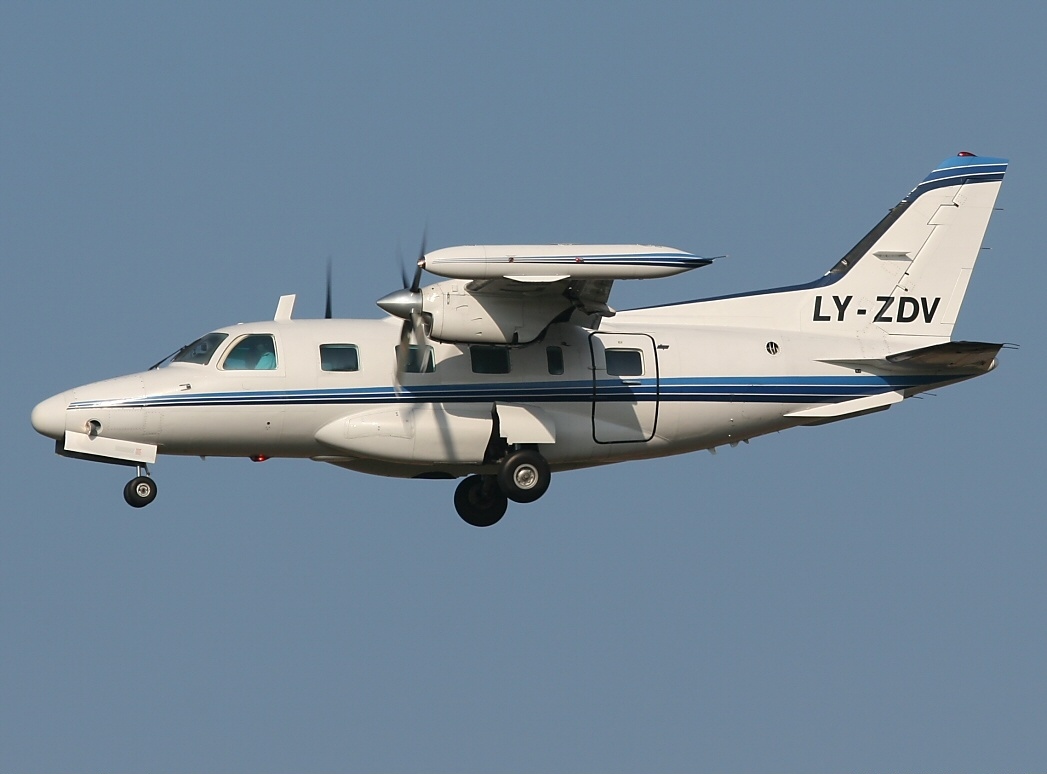
The Mitsubishi MU-2 is a medium twin turboprop produced between 1965 and 1986. Price: the Mitsubishi MU-2 is out of production and, used, the market median is around US$ 700,000. Median from Jet Tracker's price research as of 06/2026. It has a range of 1261 nm, a cruise speed of 295 kt (546 km/h), 11 seats (pilot included). In Brazil there are 12 active units in the RAB-ANAC, excluding cancelled registrations. There are 13 aircraft from this family for sale today, across 16 listings on the portals Jet Tracker tracks (global market, not Brazil only).

Source: RAB-ANAC (data as of 11/9/2026) and Jet Tracker catalog (spec sheet reviewed on 11/6/2026).

Acquisition price · pre-owned market
16 active listings (global)Jet Tracker curation · 8 sources · 6/4/2026
US$ 700.0KR$ 3.9M
market medianaging ≈ −5.7%/yr−61% vs Turboprop Twin Medium median
Entry
US$ 333.0K
model year 1969
Best value
US$ 700.0K
model year 1980
Top of range
US$ 760.0K
model year 1983
Basis
Listings
real listings
Minimum
US$ 330.0K
R$ 1.8M
Median
US$ 700.0K
R$ 3.9M
Maximum
US$ 1.4M
R$ 7.6M
Depreciation curve by year of manufacture
CAGR +6.1%/yr·1969→1983
Market median by vintage (USD). Light-blue band = min/max range observed across real listings. Points without reliable public listings (n ≤ 1) use Bluebook/curve interpolation and are flagged as lower confidence.
1 of 4 points with reduced confidence (n ≤ 1 listing observed). The estimate for these years comes from Aircraft Bluebook / market-curve interpolation, not from direct listings.
Landed in Brazil

Index ≈ ×1.23 to ×1.44 on the aircraft value, already with ferry, ANAC nationalization, IPI and ICMS.

Through a qualified importer
US$ 404.4K – 1.7M
R$ 2.2M – 9.4M · Agreement 75/91 · IPI + ICMS ~7 to 12%
Direct import
US$ 460.9K – 2.0M
R$ 2.5M – 10.9M · IPI + full ICMS ~25 to 32%

Market estimate: value + ferry + ANAC nationalization + taxes, no legal review. II, PIS and COFINS are 0% for aircraft (NCM 88.02); IPI is 6.5% (3.25% for air taxi) until Dec 31, 2026; ~4% ICMS only through a qualified importer (Agreement 75/91).

Cost per flight hour
Operate · owned
US$ 1.1K/h
R$ 6.0K/h · Variable/h
Fixed/yr
US$ 242.1K
Total/h @ 200 hrs/yr
US$ 2.3K/h
Charter · 🌎 World
US$ 1.5K – 1.8K/h
R$ 8.3K – 9.6K/h

Operate = direct cost/hour (fuel + maintenance + engine); excludes fixed costs (hangar, crew, insurance). World: hourly rate published by charter operators.

How we read this price · 8 sources · researched 6/4/2026

Median and price range for pre-owned aircraft, compiled by Jet Tracker from asking prices in listings and the price guides in the sources below, checked on 6/4/2026. 4 of 4 model years have an observed listing. The rest are estimates from the market curve between model years and are flagged in the chart.

PTAX · R$ 5.5127 / US$ · 11/09/2026

Market estimates for guidance only, not a firm quote. Confirm the value with a broker/appraiser before any transaction.

Temporal identity

First flight
Sep 14, 1963
FAA cert.
—
ANAC cert.
—
Deliveries start
—
Units produced
704

The Mitsubishi MU-2 is a pressurized twin-engine turboprop manufactured by Mitsubishi Heavy Industries between 1965 and 1986. It has a range of 1,500 nm, a cruise speed of 290 kt, a service ceiling of 29,750 ft and a maximum takeoff weight of 5,250 kg, with a maximum capacity of 11 seats and a typical configuration of 7 seats. Out of production for decades, it is found on the used market and keeps a presence in the Brazilian registry. This page has the spec sheet, the estimated cost per flight hour and the fleet registered in Brazil.

Detailed specs

Performance

Engines
2x Garrett (Honeywell) TPE331-5/-10
Maximum takeoff weight (MTOW)
11,575 lb
Max speed
340 kt
Configuration
High-wing, full-span flaps, spoilers (no ailerons)
Fuel
426.1 gal
Rate of climb
2,630 ft/min
Service ceiling
29,500 ft
Landing distance
1,850 ft
Balanced field length (BFL)
2,200 ft
Shaft horsepower per engine
715 shp

Cabin and comfort

Lavatory
Aft with curtain (belted potty)
Configuration
7-9 passengers (Solitaire/Marquise variant) in club, pressurized cabin
Cabin width
59 in
Stand-up cabin
No
Cabin height
51 in
Cabin length
16 ft
Cabin volume
7.5 m³
Differential pressurization
6 psi
Baggage capacity
44 cu ft
Cabin altitude at 25,000 ft
8,000 ft

Avionics and engines

FMS
Not equipped as standard (modern GPS retrofit)
TCAS
Optional retrofit
Cockpit
Bendix/King or Collins analog (original configuration 1965-1986)
ADS-B Out
No
Autopilot
Bendix/King KFC 200/300 or Collins APS-65
Type rating
FAA SFAR 108 mandatory training (Initial + annual Recurrent)
Autothrottle
No
Weather radar
Optional RDR-160/2000
Synthetic vision
No
Single-pilot certified
Yes

Operating costs

Data source
planephd.com, MITSUBISHI MU-2B-60 specifications, performance, operating cost (fuel burn 81.6 GPH, maintenance $87.57/hr, overhaul reserves $216.94/hr, insurance $5,222/yr) · aircraftcostcalculator.com, Mitsubishi MU-2 Marquise & Solitaire ownership/operating costs · AOPA, Mitsubishi MU-2 aircraft fact sheet (Honeywell TPE331 Dash-10, TBO >5,000 hr, cruise 280-310 kt) · planephd.com, MITSUBISHI MU-2B-25 (fuel burn 78.4 GPH, cruise 270 KIAS)
Fuel burn
100 gal/h
Last updated
2026
Engine overhaul cost
US$ 380,000
Market price (low)
US$ 400,000
Engine overhaul interval
5,400 h
Market price (high)
US$ 1,100,000

External dimensions

Overall length
12.01 m
Wingspan
11.94 m
Height
4.17 m
Wing area
16.55 m²

Weights & fuel

Operating empty weight (OEW)
3,433 kg
Maximum takeoff weight (MTOW)
5,250 kg
Fuel capacity
1,613 L
Fuel capacity
2,887 lb

Minimum runway

RBAC 135.399 · no factoring (≤ 5,670 kg, assumes normal category)sea level / ISA reference

How much runway the MU-2 needs to dispatch: the manual figure and what the charter (RBAC 135) rule requires.

Charter (RBAC 135)
671m
no factoring · RBAC 135.399, assuming normal category; small transport-category aircraft are factored (135.397)
Takeoff or BFL, manual
671m
unfactored takeoff, manufacturer

No mandatory factoring: fits 459 of 465 Brazilian public runways.

Minimum runway

Where the MU-2 dispatches under charter rules

Verdict per regime (private, charter dry and wet) across 465 Brazilian public runways, with the margin in meters.

Starter feature. Available on your Jet Tracker account.

Manufacturer-published distances at sea level, ISA and reference weight. Not corrected for altitude, temperature, wind or runway condition, takeoff included. Uses the declared LDA as a proxy for effective runway length (RBAC 135.361) and the most favourable threshold in calm air (135.385(b)(1)): on the day, wind may force the shorter threshold. Destination only: does not assess the alternate aerodrome (135.387). Not a substitute for the AFM or the operator's performance analysis. Rule: RBAC 135.385 and 135.398; private flying (RBAC 91) is not factored. Runways: declared distance (LDA) from AISWEB/DECEA (2026-09-05), checkable on each aerodrome chart; where DECEA publishes no declared distance, physical length from OurAirports is used.

Cabin

Standard configuration
1 zone7 typical seats (pilot included) · 11 max
Cabin to scale: cross-section and profile
✗ no stand-up height
1,32 m1,50 m
front cross-section · person = 1.75 m
4,88 m long
Length
4.88 m
Width
1.5 m
Height
1.32 m
Volume
7.5 m³
Baggage
—

History

  1. 1963First flight
  2. 1965 - Only Japanese business aircraft mass-produced in the West, 704 units

    The MU-2 was developed by Mitsubishi Heavy Industries in partnership with Mooney Aircraft Corporation in the US, with a first flight in September 1963 and initial certification in 1965. Production continued until 1986 with 704 units delivered in the B-10 to B-60 variants (Solitaire and Marquise). It is the only Japanese business aircraft to achieve mass production and penetration of the Western market, and marks Mitsubishi's entry into general aviation before focusing exclusively on military and industrial programs.

  3. 1986End of production

Brazil Fleet

Lineage

Model with no documented lineage in the manufacturer's line.

Curiosities and highlights

Benefits

320 kt cruise, fastest turboprop in production of its era

With the Garrett TPE331-10 (776 SHP) on the Marquise variant (B-60), the MU-2 reaches 320 kt in high cruise, jet-like performance that places the MU-2 among the fastest executive turboprops ever produced, comparable to early Citation jets. The speed comes from the aerodynamically optimized fuselage, short-span wing and reduced drag from the absence of ailerons (replaced by spoilers).

Full-span flaps deliver surprising STOL in a medium turboprop twin

The combination of full-span flaps (the entire trailing edge is flap) with spoilers for roll control delivers extraordinarily high lift coefficients on takeoff and landing, allowing a balanced field of approximately 2,200 ft, similar to the King Air and better than the Conquest II. This enabled operation at short runways often impossible for turboprops in the same speed range.

Limitations

Bad reputation from accidents in the 1980s, eventually attributed to training, not design

During the 1970s-80s, the MU-2 accumulated a high accident rate that generated a controversial reputation among pilots and insurers. The FAA conducted multiple investigations between 1984 and 2008, including the 1997 Special Certification Review, which concluded that the aircraft's design was safe but required a specific piloting technique different from the conventional (especially in V1 cuts and missed approaches). In February 2008 the FAA issued SFAR 108, making Initial and annual Recurrent training at accredited centers mandatory; after its implementation, the accident rate fell to levels comparable to or lower than the rest of the category.

Spoilers instead of ailerons require a different roll control technique

The spoiler system for roll control (instead of conventional ailerons) makes the airplane extremely responsive at high speed but requires a different technique at low speed, particularly in short approach and missed approach situations. Pilots with prior experience in conventional twins (King Air, Conquest) often underestimate the transition. That is why SFAR 108 emphasizes specific simulator training for these techniques and keeps the fleet in safe operation.

Curiosities

PT6A vs Garrett variants, two engine lineages (but only Garrett prevailed)

Although the vast majority of MU-2s produced use the Garrett TPE331, there was an experimental MU-2C variant with the PT6A early in the program that did not succeed commercially. The final variants Solitaire (short, B-40) and Marquise (long, B-60), both with the TPE331-10, were the most successful and represent approximately 70% of the remaining fleet. Ironically, the choice of the Garrett (noisier) was the target of historical criticism, but it is considered an advantage today for delivering greater power and speed that justified the MU-2's jet-like reputation.

Catalogued accidents

Sources: NTSB, CENIPA, Aviation Safety Network

1/25/2013· BR· GOIÂNIA
PR-JFN
Serious

Landing gear occurrence

6/22/2012· BR· BRASÍLIA
PT-ICD
Serious

Landing short of the runway

7/14/2011· BR· ILHÉUS
PT-LHH
Minor

Landing gear occurrence

9/26/2007· BR· BREVES
PT-WIX
Minor

Engine failure in flight

Mitsubishi MU-2 for sale now

Listed aircraft with a page on Jet Tracker, from the lowest asking price up. Asking is not the closing price; portals and the reading date are on each page.

Registrations in Brazil

5 operational aircraft owned by companies in the ANAC registry (RAB). Each opens the profile with owner, operator, status and history.

PR-LUEPR-STDPR-STPPS-ZEUPT-WNS

Frequently asked questions

How much does the Mitsubishi MU-2 cost?

The Mitsubishi MU-2 is out of production, so there is no factory price. On the used market the median is around US$ 700,000, varying with year and flight hours; see real listings on this model's Market tab. Reference value as of 06/2026.

What is the range of the Mitsubishi MU-2?

The maximum range is 1261 nm (1,261 NM · 2,335 km).

How fast is the Mitsubishi MU-2?

Cruise speed is 295 kt, equivalent to 546 km/h.

How many passengers does the Mitsubishi MU-2 seat?

The Mitsubishi MU-2 has 11 seats in total, counting the pilot seat: up to 9 passengers.

How many Mitsubishi MU-2 are there in Brazil?

There are 12 active units in the RAB-ANAC (data as of 11/9/2026): operational, mark reservation or suspended, excluding cancelled registrations.

Who operates the Mitsubishi MU-2 in Brazil?

9 distinct operators operate 12 units of the Mitsubishi MU-2 in the RAB-ANAC: 4 in air taxi (RBAC 135) and 8 in private operation (RBAC 91), concentrated in GO, SP and MT (data as of 11/9/2026). Name, fleet and state of each operator are on this model's Analytics tab and in the operators directory.

How much does it cost to operate the Mitsubishi MU-2 per hour?

Jet Tracker estimate: about US$ 2,299 per flight hour at 200 h/year, of which US$ 1,089 per hour is variable cost (fuel, engine program, maintenance reserves) plus US$ 242,050 per year of fixed cost (crew, hangar, insurance), under Jet Tracker's default assumptions (Southeast Brazil, in-house crew, 200 h/year). Run your own scenario on this model's Costs tab.