Citation CJ3Citation CJ3 +2014–2025
RangeMTOWCruiseCeilingCabin volume
Key changes
Detailed variants pending.

C25BThe Cessna Citation CJ3 is a light jet produced between 2004 and 2014. Price: the Cessna Citation CJ3 is out of production and, used, the market median is around US$ 4.8M. Median from Jet Tracker's price research as of 06/2026. It has a range of 1875 nm, a cruise speed of 414 kt (767 km/h), Mach 0.737, up to 9 passengers. In Brazil there are 27 active units in the RAB-ANAC, excluding cancelled registrations. The Citation CJ3 family (3 variants) totals 64 active units. There are 76 aircraft from this family for sale today, across 86 listings on the portals Jet Tracker tracks (global market, not Brazil only).
Source: RAB-ANAC (data as of 11/8/2026) and Jet Tracker catalog (spec sheet reviewed on 11/8/2026).
Index ≈ ×1.09 to ×1.36 on the aircraft value, already with ferry, ANAC nationalization, IPI and ICMS.
Market estimate: value + ferry + ANAC nationalization + taxes, no legal review. II, PIS and COFINS are 0% for aircraft (NCM 88.02); IPI is 6.5% (3.25% for air taxi) until Dec 31, 2026; ~4% ICMS only through a qualified importer (Agreement 75/91).
Operate = direct cost/hour (fuel + maintenance + engine); excludes fixed costs (hangar, crew, insurance). World: hourly rate published by charter operators. Brazil: charter is quoted per leg, so the hourly figure is an estimate from route quotes.
Median and price range for pre-owned aircraft, compiled by Jet Tracker from asking prices in listings and the price guides in the sources below, checked on 6/4/2026. 1 of 7 model years has an observed listing. The rest are estimates from the market curve between model years and are flagged in the chart.
PTAX · R$ 5.518 / US$ · 11/06/2026
Market estimates for guidance only, not a firm quote. Confirm the value with a broker/appraiser before any transaction.
The Cessna Citation CJ3 is a twin-engine light jet with a range of 1,875 nm and a cruise speed of 414 kt. The cabin seats up to 9 occupants, with a typical configuration of 7 seats, and the service ceiling reaches 45,000 ft. The maximum takeoff weight is 6,291 kg. On this page you will find the full spec sheet, the estimated operating cost per flight hour, market listings, and the fleet registered in Brazil, with registrations, operators, and the evolution over time.
How much runway the Citation CJ3 needs to dispatch: the manual figure and what the charter (RBAC 135) rule requires.
Dispatches under charter rules at 226 of 465 Brazilian public runways when dry, and at 127 when wet.
Verdict per regime (private, charter dry and wet) across 465 Brazilian public runways, with the margin in meters.
Starter feature. Available on your Jet Tracker account.
Manufacturer-published distances at sea level, ISA and reference weight. Not corrected for altitude, temperature, wind or runway condition, takeoff included. Uses the declared LDA as a proxy for effective runway length (RBAC 135.361) and the most favourable threshold in calm air (135.385(b)(1)): on the day, wind may force the shorter threshold. Destination only: does not assess the alternate aerodrome (135.387). Not a substitute for the AFM or the operator's performance analysis. Rule: RBAC 135.385 and 135.398; private flying (RBAC 91) is not factored. Runways: declared distance (LDA) from AISWEB/DECEA (2026-09-05), checkable on each aerodrome chart; where DECEA publishes no declared distance, physical length from OurAirports is used.
Typical factory configuration (curated data). The drawing below is schematic and at approximate scale; the actual layout varies by interior and year.
Detailed variants pending.
Detailed variants pending.
The Citation CJ3 (Model 525B) was announced in 2002 as an evolution of the CJ2, with a fuselage stretched by 0.61 m, more powerful Williams FJ44-3A engines and a new wing with more fuel. First flight on April 17, 2003.
FAA certification obtained in October 2004, with first deliveries in December of the same year. Single-pilot RVSM/RNP-AR certification was a competitive differentiator since launch.
Between 2004 and 2014, Cessna produced approximately 450 CJ3 units, making it one of the most successful light jets in history. Replaced by the CJ3+ in 2014, which is essentially the same airplane with the Garmin G3000 replacing the Pro Line 21.
In 2014, Cessna launched the CJ3+ with Garmin G3000 avionics (Cessna Intrinzic), ending production of the original CJ3. A total of 451 CJ3 units produced in 10 years, a solid commercial success in the light category.
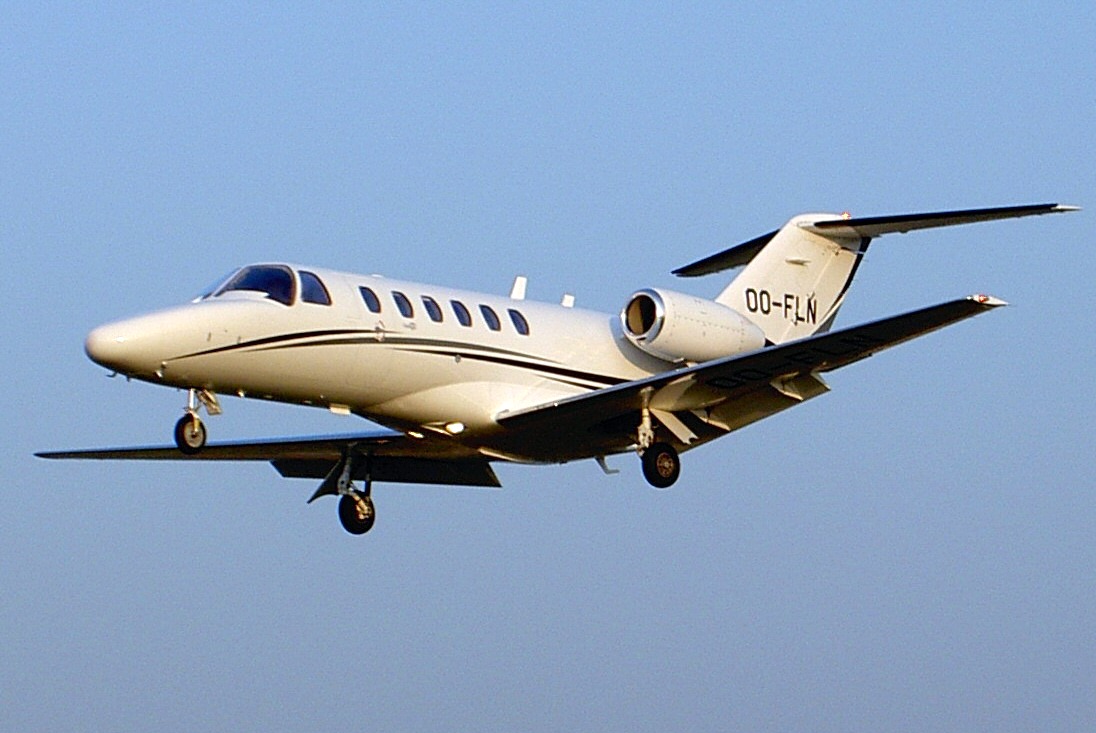
Range of 1,875 nm allows direct flights such as Manaus-Bridgetown without refueling. Combined with FL450, it opens premium routes for weekend charters with family + baggage.
First CJ to offer a lavatory with a solid door (enclosed); before, there was only a privacy curtain on the CJ1/CJ2. The external baggage compartment of 65 ft³ (~1,840 L) fits golf bags and medium-sized suitcases for 6-7 people, rare in a light single-pilot.
With 3,180 ft of balanced field length (shorter than the CJ1+!) and single-pilot certified, it operates from Jundiai and Sorocaba without restriction. Brazilian operators such as Avantto, JetSmart and NetJets have the CJ3 in their fleets as a workhorse for 2-4 hour missions.
The CJ3 is certified for single-pilot operation, dispensing with a mandatory SIC. For owner-operators, this reduces annual operating cost by US$ 80-100k (salary + benefits + SIC training). The CE-525 type rating covers the entire CitationJet family (CJ1/CJ2/CJ3/CJ4/M2).
The Williams FJ44-3A engines operate under the TAP Blue (Total Assurance Program), offering per-flight-hour coverage with budget predictability. TBO of 5,000 hours and HSI at 2,500h are competitive with the Phenom 300's PW535.
With 3,180 ft of balanced field length, the CJ3 operates at SBJD (Jundiaí, 1,745m), SBSO (Sorocaba) and SBKP (Campinas) without restriction. In Brazil, this avoids Guarulhos/Congonhas and reduces handling/landing costs.
Cabin height remains at 1.45m, identical since the 1993 CitationJet, a structural limit of the 525 fuselage. Newer competitors such as the Phenom 300 and Praetor 500 already offer taller cabins (1.52m and 1.83m respectively).
The CJ3 cabin is 1.45m high; passengers have to duck their heads when walking. Width of 1.47m equals the Hawker 400XP but is less than the Phenom 300 (1.55m) and much smaller than the Sovereign (1.68m).
The CJ3 has no APU. On the ground, air conditioning and engine start depend on a GPU, a limitation at FBOs without adequate infrastructure. In hot climates (Brazilian summer), passengers may be uncomfortable between boarding and pushback.
Considering all variants of the Citation 525 family (original CJ 1993, CJ1, CJ1+, CJ2, CJ2+, CJ3, CJ3+, CJ4, M2), Cessna has delivered more than 2,500 units, making it one of the most successful business jet families in history, alongside the Hawker family and the Falcon 7X/8X.
Pilots with a CE-525 type rating can legally fly the CJ1/CJ1+/CJ2/CJ2+/CJ3/CJ3+/CJ4/M2 with no additional training, one of the largest jet families covered by a single type rating. This eases migration between models in the fractional and charter market.
NetJets added the CJ3 to its fractional fleet in 2005 and operated approximately 30 units at the peak (2008-2014), creating global familiarity with the type among pilots and technicians. Today NetJets has migrated to the CJ4 and Phenom 300, but the CJ3 legacy sustains the pre-owned market.
In Brazil, the CJ3 is frequently operated by agribusiness entrepreneurs in MT, GO and MS. The combination of single-pilot + short runway + 1,875 nm range (which covers farms in the Center-West region to SP/RJ nonstop) is a "sweet spot" for the sector.
Sources: NTSB, CENIPA, Aviation Safety Network
Long landing
40 operational aircraft owned by companies in the ANAC registry (RAB), across the Citation CJ3 family (3 variants). Each opens the profile with owner, operator, status and history.
PP-BIHPP-FCFPP-OVOPP-PGAPP-RCAPR-BHVPR-EDBPR-JRVPR-MTQPR-PLUPR-RCFPR-SCFPR-TBLPR-VNAPS-ACLPS-CSJPS-DGEPS-ECFPS-FCCPS-GBFPS-INBPS-INJPS-LOTPS-MAOPS-MBKPS-MBOPS-PDLPS-PFDPS-PGAPS-PLAPS-RHTPS-RPCPS-RRRPS-SCCPS-TRDPS-WRAPS-ZMBPT-GBFPT-GMUPT-TJS
The Cessna Citation CJ3 is out of production, so there is no factory price. On the used market the median is around US$ 4.8M, varying with year and flight hours; see real listings on this model's Market tab. Reference value as of 06/2026.
The maximum range is 1875 nm (1,875 NM · 3,473 km).
Cruise speed is 414 kt, equivalent to 767 km/h, or Mach 0.737.
The Cessna Citation CJ3 seats up to 9 passengers, crew not included.
There are 27 active units in the RAB-ANAC (data as of 11/8/2026): operational, mark reservation or suspended, excluding cancelled registrations. The Citation CJ3 family (3 variants) totals 64 active units.
25 distinct operators operate 26 units of the Cessna Citation CJ3 in the RAB-ANAC: 4 in air taxi (RBAC 135) and 22 in private operation (RBAC 91), concentrated in SP, MT and PR (data as of 11/8/2026). Another 1 unit is under registration reservation (tail number reserved, not yet operating). Name, fleet and state of each operator are on this model's Analytics tab and in the operators directory.
Jet Tracker estimate: about US$ 3,735 per flight hour at 200 h/year, of which US$ 2,345 per hour is variable cost (fuel, engine program, maintenance reserves) plus US$ 278,050 per year of fixed cost (crew, hangar, insurance), under Jet Tracker's default assumptions (Southeast Brazil, in-house crew, 200 h/year). Run your own scenario on this model's Costs tab.