Citation XCitation X +2014–2018
RangeMTOWCruiseCeilingCabin volume
Key changes
Detailed variants pending.
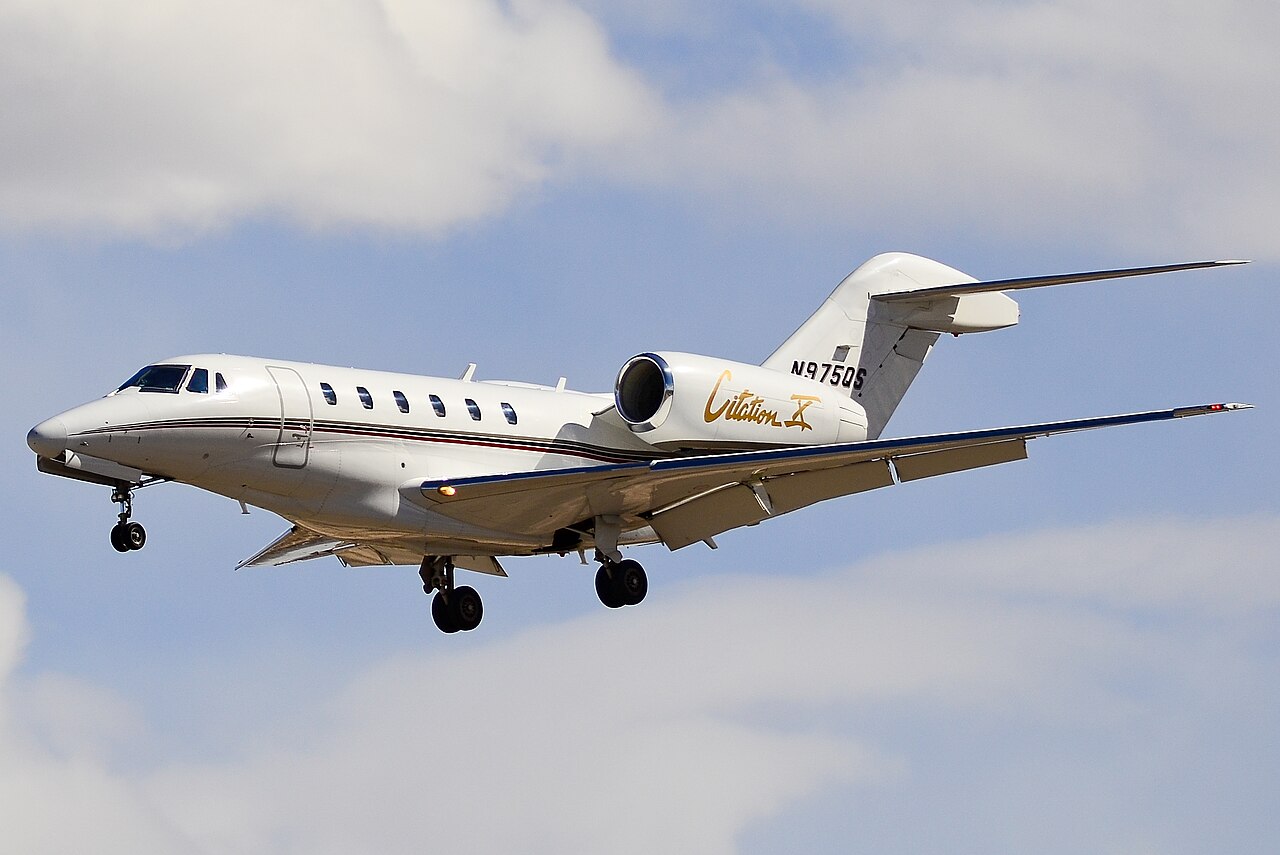
C750The Cessna Citation X is a super-midsize jet produced between 1996 and 2014. Price: the Cessna Citation X is out of production and, used, the market median is around US$ 4.5M. Median from Jet Tracker's price research as of 06/2026. It has a range of 3070 nm, a cruise speed of 527 kt (976 km/h), Mach 0.92, up to 12 passengers. In Brazil there are 9 active units in the RAB-ANAC, excluding cancelled registrations. There are 22 aircraft from this family for sale today, across 33 listings on the portals Jet Tracker tracks (global market, not Brazil only).
Source: RAB-ANAC (data as of 11/9/2026) and Jet Tracker catalog (spec sheet reviewed on 11/8/2026).
Index ≈ ×1.11 to ×1.36 on the aircraft value, already with ferry, ANAC nationalization, IPI and ICMS.
Market estimate: value + ferry + ANAC nationalization + taxes, no legal review. II, PIS and COFINS are 0% for aircraft (NCM 88.02); IPI is 6.5% (3.25% for air taxi) until Dec 31, 2026; ~4% ICMS only through a qualified importer (Agreement 75/91).
Operate = direct cost/hour (fuel + maintenance + engine); excludes fixed costs (hangar, crew, insurance). World: hourly rate published by charter operators. Brazil: charter is quoted per leg, so the hourly figure is an estimate from route quotes.
Median and price range for pre-owned aircraft, compiled by Jet Tracker from asking prices in listings and the price guides in the sources below, checked on 6/4/2026. 2 of 6 model years have an observed listing. The rest are estimates from the market curve between model years and are flagged in the chart.
PTAX · R$ 5.5127 / US$ · 11/09/2026
Market estimates for guidance only, not a firm quote. Confirm the value with a broker/appraiser before any transaction.
The Citation X is Cessna's super-midsize jet, produced between 1996 and 2014 and identified by ICAO code C750. It combines a cruise speed of 527 kt, a range of 3,070 nm, and a service ceiling of 51,000 ft, with a maximum takeoff weight of 16,193 kg. The cabin carries 8 passengers in the typical configuration and reaches 12 seats; the list price of a new unit was US$23 million. Since the model went out of production in 2014, those who buy or operate in Brazil need to assess maintenance history, engine programs, and parts and support availability.
How much runway the Citation X needs to dispatch: the manual figure and what the charter (RBAC 135) rule requires.
Dispatches under charter rules at 104 of 465 Brazilian public runways when dry, and at 68 when wet.
Verdict per regime (private, charter dry and wet) across 465 Brazilian public runways, with the margin in meters.
Starter feature. Available on your Jet Tracker account.
Manufacturer-published distances at sea level, ISA and reference weight. Not corrected for altitude, temperature, wind or runway condition, takeoff included. Uses the declared LDA as a proxy for effective runway length (RBAC 135.361) and the most favourable threshold in calm air (135.385(b)(1)): on the day, wind may force the shorter threshold. Destination only: does not assess the alternate aerodrome (135.387). Not a substitute for the AFM or the operator's performance analysis. Rule: RBAC 135.385 and 135.398; private flying (RBAC 91) is not factored. Runways: declared distance (LDA) from AISWEB/DECEA (2026-09-05), checkable on each aerodrome chart; where DECEA publishes no declared distance, physical length from OurAirports is used.
Typical factory configuration (curated data). The drawing below is schematic and at approximate scale; the actual layout varies by interior and year.
Detailed variants pending.
Certified for Mach 0.92 (Mmo) and a typical cruise of Mach 0.90, it has been the fastest business jet in the world since 1996, surpassed only by the supersonic Concorde. It holds the civil subsonic speed record that remains unbeaten in 2024. The later Citation X+ raised Mmo to Mach 0.935.
Cessna received the prestigious Collier Trophy in 1996 for the Citation X, the second business jet to win the award in history (after the Learjet 23). Recognition of innovation in high-speed civil aviation. Replaced by the Citation X+ in 2014.
Cruise at FL510, 6,000 ft above the dense commercial traffic of FL370-410. Advantages: direct routes without holding, minimal vectoring, reduced turbulence. The Citation X frequently received direct routing from ATC because of its unique altitude.
LAX-JFK in 3h54m coast-to-coast against 4h30m for the Challenger 300. On long routes (Miami-Buenos Aires), a saving of 35-40 minutes vs. super-midsize competitors. For CEOs with tight schedules, it justifies the speed premium.
A 1.73 m cabin (not stand-up) and 1.68 m width is smaller than the Challenger 300 (1.85 m × 2.19 m), Falcon 2000 (1.88 m × 2.34 m) or G280 (1.93 m × 2.15 m). A clear trade-off: speed over comfort. The 82 ft³ baggage compartment is also the smallest in the segment.
During Cessna flight tests, it reached Mach 0.935 in a dive, a record not officially published but widely known. The Citation X+ (2014) was officially certified at Mach 0.935 Mmo, doing justice to the platform's real limit.
Listed aircraft with a page on Jet Tracker, from the lowest asking price up. Asking is not the closing price; portals and the reading date are on each page.
6 operational aircraft owned by companies in the ANAC registry (RAB), across the Citation X family (2 variants). Each opens the profile with owner, operator, status and history.
The Cessna Citation X is out of production, so there is no factory price. On the used market the median is around US$ 4.5M, varying with year and flight hours; see real listings on this model's Market tab. Reference value as of 06/2026.
The maximum range is 3070 nm (3,070 NM · 5,686 km).
Cruise speed is 527 kt, equivalent to 976 km/h, or Mach 0.92.
The Cessna Citation X seats up to 12 passengers, crew not included.
There are 9 active units in the RAB-ANAC (data as of 11/9/2026): operational, mark reservation or suspended, excluding cancelled registrations.
9 distinct operators operate 9 units of the Cessna Citation X in the RAB-ANAC: 9 in private operation (RBAC 91), concentrated in SP, ES and DF (data as of 11/9/2026). Name, fleet and state of each operator are on this model's Analytics tab and in the operators directory.
Jet Tracker estimate: about US$ 8,010 per flight hour at 200 h/year, of which US$ 4,858 per hour is variable cost (fuel, engine program, maintenance reserves) plus US$ 630,500 per year of fixed cost (crew, hangar, insurance), under Jet Tracker's default assumptions (Southeast Brazil, in-house crew, 200 h/year). Run your own scenario on this model's Costs tab.