Skip to content

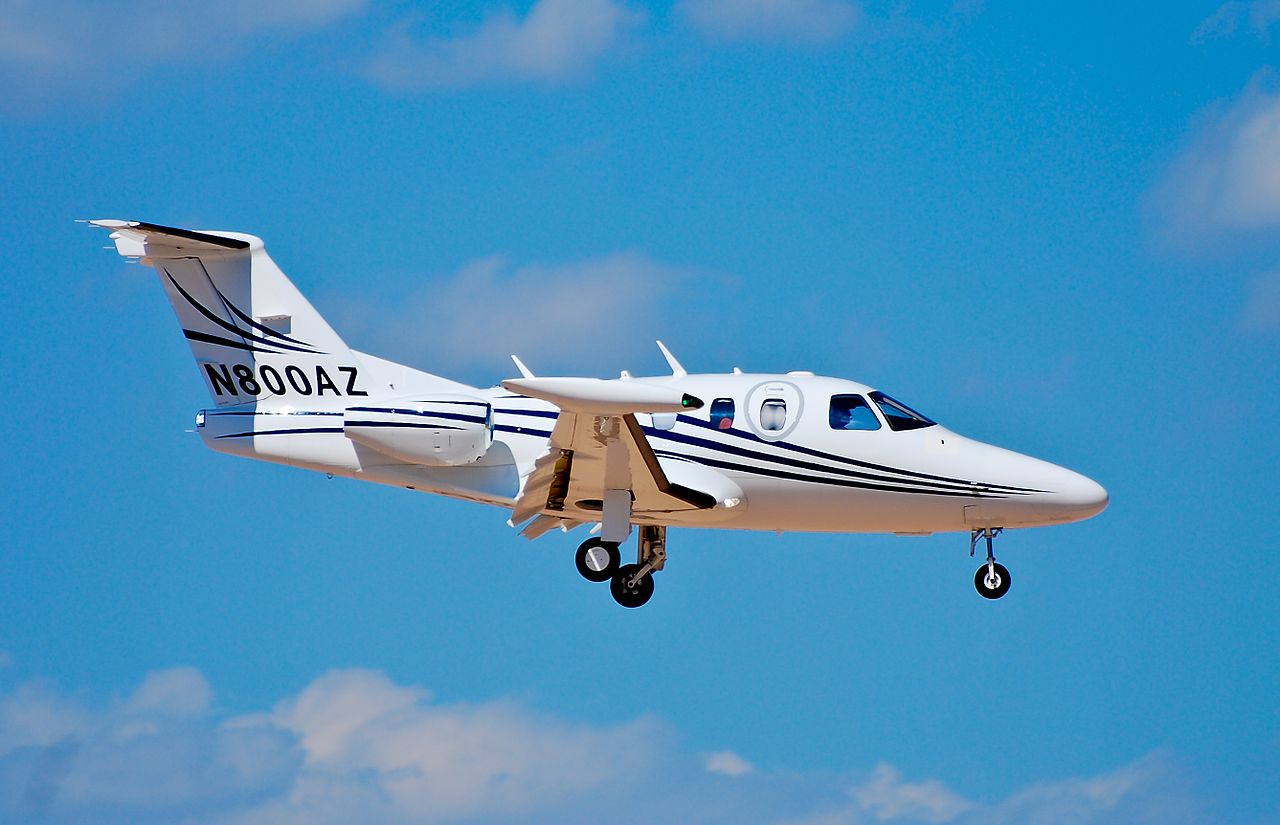
The Eclipse 500 is a very light jet produced between 2006 and 2008. Price: the Eclipse 500 is out of production and, used, the market median is around US$ 1.2M. Median asking price across 10 aircraft listed outside Brazil, snapshot of 11/2026. It has a range of 1125 nm, a cruise speed of 370 kt (685 km/h), Mach 0.64, 6 seats (pilot included). In Brazil there are 3 active units in the RAB-ANAC, excluding cancelled registrations. There are 31 aircraft from this family for sale today, across 32 listings on the portals Jet Tracker tracks (global market, not Brazil only).

Source: ANAC (data as of 11/20/2026) and Jet Tracker catalog (spec sheet reviewed on 10/10/2026).

Acquisition price · pre-owned market
32 active listings (global)Listings outside Brazil · 10 priced aircraft · 11/19/2026
US$ 1.2MR$ 7.3M
median asking price outside Brazil

Source: sale listings, 11/19/2026; model-year curve: Jet Tracker research, 6/4/2026. This is the asking price, not the closed sale price. PTAX · R$ 5.8862 / US$ · 11/19/2026

Market estimates for guidance only, not a firm quote. Confirm the value with a broker/appraiser before any transaction.

Temporal identity

First flight
Aug 26, 2002
FAA cert.
Sep 30, 2006
ANAC cert.
—
Deliveries start
Dec 31, 2006
Units produced
260

The Eclipse 500 is a very light jet built by Eclipse Aviation between 2006 and 2008, identified by ICAO code EA50. It has a range of 1,125 nm, a cruise speed of 370 kt, and a service ceiling of 41,000 ft. The cabin is usually configured for 4 passengers and reaches 5 seats, with a maximum takeoff weight of 2,722 kg. This page has the spec sheet, the estimated operating cost per flight hour, and the Eclipse 500 fleet registered in Brazil, with registrations and operators.

Detailed specs

Performance

Engines
2x Pratt & Whitney Canada PW610F with FADEC
Max Mach
0.64
Max speed
370 kt
Fuel
253.1 gal
Rate of climb
3,424 ft/min
Max operating Mach
0.64
Landing distance
2,250 ft
Thrust per engine
900 lbf
Time to climb to FL410
18 min
Balanced field length (BFL)
2,342 ft
Max certified altitude
41,000 ft

Cabin and comfort

Seats
6
Lavatory
No enclosed lavatory (basic version), optional dry-flush
Cabin width (alternate source)
1.43 m
Configuration
Typically 4 passengers (club + 2 or 2+2), compact cabin
Cabin length (alternate source)
3.66 m
Typical configuration
Club 4
Cabin noise
78 dB
Stand-up cabin
No
Differential pressurization
8.7 psi
Baggage capacity
16 cu ft

Avionics and engines

TCAS
I
FADEC
Yes
Cockpit
Avio NG (original Eclipse 500) or IS&S integrated (550 upgrade)
ADS-B Out
No
Autopilot
Integrated Avio NG
Flight deck
Avio NG
Weather radar
Optional Skywatch HP TAS
Common retrofits
ADS-B Out, IS&S avionics upgrade, Total Eclipse modernization
Synthetic vision
No
Single-pilot certified
Yes

Operating costs

Data source
Liberty Jet, Eclipse 500 jet ownership costs (variable/fixed breakdown, engine reserves $246.11/h, maint $173.93/h, fuel $426.57/h) · FlyRadius, Eclipse 500 fuel burn (48-59 gph cruise) · planephd, Total Eclipse 500 specifications/operating cost (overhaul reserves, maintenance, fixed costs) · Pratt & Whitney Canada PW610F / FlyRadius, engine TBO 3,500h, twin installation
Fuel burn
70 gal/h
Last updated
2026
Engine overhaul cost
US$ 200,000
Market price (low)
US$ 999,750
Engine overhaul interval
3,500 h
Market price (high)
US$ 1,399,750
Market range basis
Typical asking range, 10 listed aircraft (11/19/2026)

External dimensions

Overall length
10.2 m
Wingspan
11.6 m
Height
3.4 m
Wing area
13.38 m²

Weights & fuel

Operating empty weight (OEW)
1,648 kg
Maximum takeoff weight (MTOW)
2,722 kg
Fuel capacity
958 L
Fuel capacity
1,715 lb

Minimum runway

RBAC 135.399 · no factoring (≤ 5,670 kg, assumes normal category)sea level / ISA reference

How much runway the Eclipse 500 needs to dispatch: the manual figure and what the charter (RBAC 135) rule requires.

Charter (RBAC 135)
714m
no factoring · RBAC 135.399, assuming normal category; small transport-category aircraft are factored (135.397)
Takeoff or BFL, manual
714m
unfactored takeoff, manufacturer

No mandatory factoring: fits 455 of 465 Brazilian public runways.

Minimum runway

Where the Eclipse 500 dispatches under charter rules

Verdict per regime (private, charter dry and wet) across 465 Brazilian public runways, with the margin in meters.

Starter feature. Available on your Jet Tracker account.

Manufacturer-published distances at sea level, ISA and reference weight. Not corrected for altitude, temperature, wind or runway condition, takeoff included. Destination only. Not a substitute for the AFM or the operator's performance analysis. Private flying (RBAC 91) is not factored. Runways: DECEA data (2026-09-05), checkable on each aerodrome chart.

Cabin

Standard configuration
1 zone4 typical seats (pilot included) · 6 maxClub 4

Typical factory configuration (curated data). The drawing below is schematic and at approximate scale; the actual layout varies by interior and year.

Cabin to scale: cross-section and profile
✗ no stand-up height
1,27 m1,42 m
front cross-section · person = 1.75 m
3,78 m long
Length
3.78 m
Width
1.42 m
Height
1.27 m
Volume
—
Baggage
—

History

  1. 2002First flight
  2. 2006 - First FAA-certified VLJ of the modern era

    In September 2006 the Eclipse 500 received its FAA Type Certificate, being the first certified Very Light Jet (VLJ) of the modern era, a category created for jets under 4,535 kg MTOW intended for single-pilot operation and reduced acquisition cost. It marked the start of the 'jet democratization' concept that also included the Cessna Mustang (2006) and Embraer Phenom 100 (2008).

  3. 2006FAA certification
  4. 2006First deliveries
  5. 2008 - Eclipse Aviation entered Chapter 11 in 2008

    In November 2008 Eclipse Aviation filed for Chapter 11 in the US; after receiving 2,700+ orders and producing about 260 units, the company could not sustain the business model with a list price below the real cost of production. Thousands of customers who had paid deposits of US$ 100-150 thousand lost their money, marking one of the largest bankruptcies in the history of American business aviation.

  6. 2008End of production
  7. 2017 - Rebirth as the Eclipse 550 without commercial success

    In 2009 Eclipse Aerospace (a new company formed by investors) acquired the assets and relaunched the program as the Eclipse 550 in 2013, with IS&S avionics, ADS-B, autothrottle and synthetic vision. Despite the improvements, it sold few units and production was suspended in 2017. The program was later sold to AML Global and One Aviation, all with frustrated relaunch attempts.

Brazil Fleet

Lineage

Model with no documented lineage in the manufacturer's line.

Curiosities and highlights

Benefits

Low operating cost for the jet category

With fuel burn of only 70 gph and a direct operating cost in the range of US$ 950/hour, the Eclipse 500 is one of the lowest operating cost jets ever produced, comparable to a turboprop like the King Air C90, but with jet performance (370kt, FL410). It attracts operators who need jet speed at a cost close to the TBM 700.

Limitations

Extremely compact cabin with 4 passengers

A cabin 1.27m high and only 16 ft³ of baggage (basic version) limits use to short missions with 3-4 passengers and minimal baggage. Without a native enclosed lavatory, comfort is below the Mustang and Phenom 100. For operators who need to carry a family + baggage, it is clearly undersized.

Long-term risk in technical and parts support

With Eclipse Aviation bankrupt in 2008 and its successors (Eclipse Aerospace, AML Global, One Aviation) having commercial difficulties, support for parts, maintenance and service bulletins has been weakened over the years. Buyers need to carefully diligence parts availability, mandatory updates and ADs in force, a material risk for a long-term purchase decision.

Curiosities

More than 260 units produced before bankruptcy

Eclipse Aviation delivered approximately 260 Eclipse 500 units between 2006 and 2008, before Chapter 11. Counting the Eclipse 550s produced by Eclipse Aerospace (2013-2017), the total for the EA500/550 family is around 280 units, quite low compared with the Cessna Mustang (475) and Embraer Phenom 100 (400+). Most operate in the US and a few dozen in Europe.

Air-taxi operator DayJet failed along with Eclipse

DayJet, an American on-demand air-taxi operator founded in 2002, based its entire business model on a fleet of 28 Eclipse 500s and had orders for another 1,350 units. It ceased operations in September 2008, two months before the Eclipse Aviation bankruptcy, in a cascade from the drop in jet orders. The case became a classic aviation case study on the risks of VLJ-dependent models.

Eclipse 500 for sale now

Listed aircraft with a page on Jet Tracker, from the lowest asking price up. Asking is not the closing price; portals and the reading date are on each page.

Registrations in Brazil

1 operational aircraft owned by companies. Each opens the profile with owner, operator, status and history.

PS-KZA

Frequently asked questions

How much does the Eclipse 500 cost?

The Eclipse 500 is out of production, so there is no factory price. On the used market the median is around US$ 1.2M, varying with year and flight hours; see real listings on this model's Market tab. Median asking price across 10 aircraft listed outside Brazil, snapshot of 11/2026.

What is the range of the Eclipse 500?

The maximum range is 1125 nm (1,125 NM · 2,084 km).

How fast is the Eclipse 500?

Cruise speed is 370 kt, equivalent to 685 km/h, or Mach 0.64.

How many passengers does the Eclipse 500 seat?

The Eclipse 500 has 6 seats in total, counting the pilot seat: up to 5 passengers.

How many Eclipse 500 are there in Brazil?

There are 3 active units in the RAB-ANAC (data as of 11/20/2026): operational, mark reservation or suspended, excluding cancelled registrations.

Who operates the Eclipse 500 in Brazil?

3 distinct operators operate 3 units of the Eclipse 500 in the RAB-ANAC: 3 in private operation (RBAC 91), concentrated in GO and SC (data as of 11/20/2026). Name, fleet and state of each operator are on this model's Analytics tab and in the operators directory.

How much does it cost to operate the Eclipse 500 per hour?

Jet Tracker estimate: about US$ 2,514 per flight hour at 200 h/year, of which US$ 1,563 per hour is variable cost (fuel, engine program, maintenance reserves, catering and crew travel expenses) plus US$ 190,082 per year of fixed cost (crew, hangar, insurance), under Jet Tracker's default assumptions (Southeast Brazil, in-house crew, 200 h/year). Run your own scenario on this model's Costs tab.

Guides and articles about this model