Challenger 300Challenger 3502014–2022
RangeMTOWCruiseCeilingCabin volume
Key changes
Detailed variants pending.
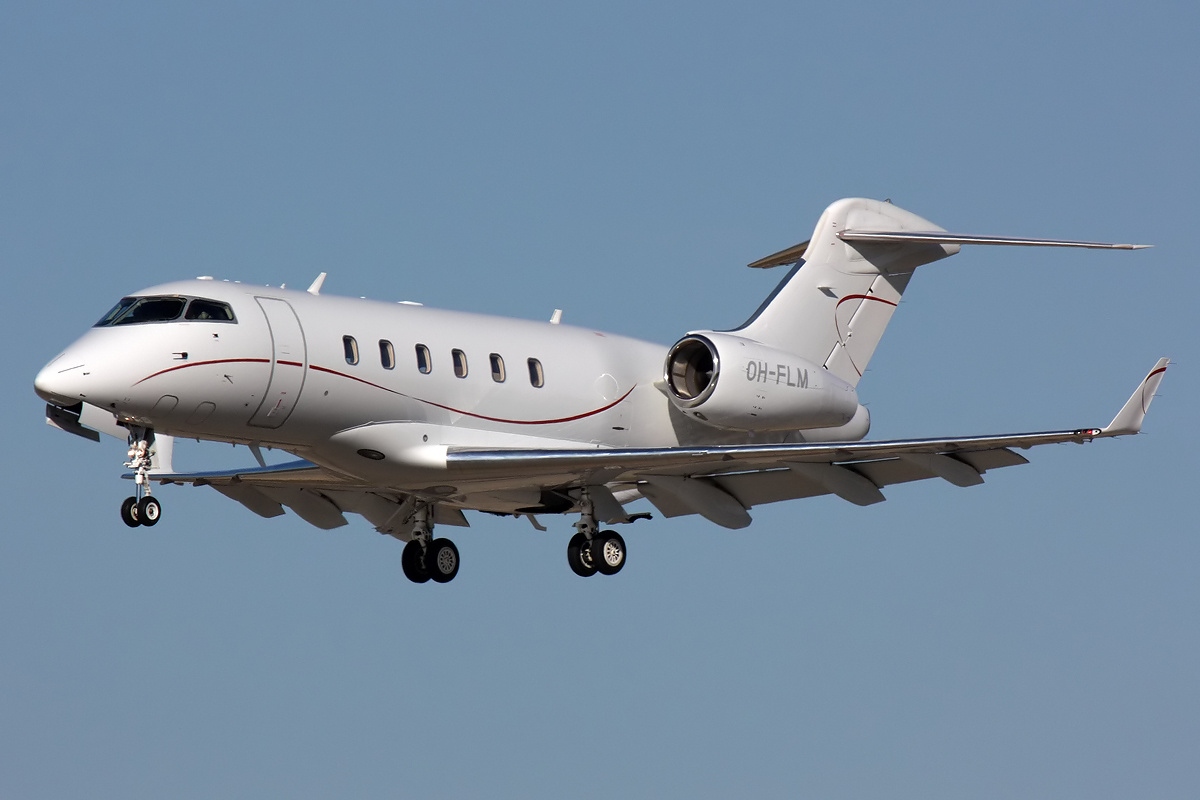
CL30The Bombardier Challenger 300 is a super-midsize jet produced between 2003 and 2014. Price: the Bombardier Challenger 300 is out of production and, used, the market median is around US$ 11.0M. Median from Jet Tracker's price research as of 06/2026. It has a range of 3100 nm, a cruise speed of 470 kt (870 km/h), Mach 0.83, up to 9 passengers. In Brazil there are 10 active units in the RAB-ANAC, excluding cancelled registrations. The Challenger 300 family (3 variants) totals 17 active units. There are 61 aircraft from this family for sale today, across 91 listings on the portals Jet Tracker tracks (global market, not Brazil only).
Source: RAB-ANAC (data as of 11/9/2026) and Jet Tracker catalog (spec sheet reviewed on 11/8/2026).
Index ≈ ×1.10 to ×1.34 on the aircraft value, already with ferry, ANAC nationalization, IPI and ICMS.
Market estimate: value + ferry + ANAC nationalization + taxes, no legal review. II, PIS and COFINS are 0% for aircraft (NCM 88.02); IPI is 6.5% (3.25% for air taxi) until Dec 31, 2026; ~4% ICMS only through a qualified importer (Agreement 75/91).
Operate = direct cost/hour (fuel + maintenance + engine); excludes fixed costs (hangar, crew, insurance). World: hourly rate published by charter operators.
Median and price range for pre-owned aircraft, compiled by Jet Tracker from asking prices in listings and the price guides in the sources below, checked on 6/4/2026. 2 of 5 model years have an observed listing. The rest are estimates from the market curve between model years and are flagged in the chart.
PTAX · R$ 5.5127 / US$ · 11/09/2026
Market estimates for guidance only, not a firm quote. Confirm the value with a broker/appraiser before any transaction.
The Challenger 300 is Bombardier's super-midsize jet, built between 2003 and 2014 and succeeded in the line by the Challenger 350. The catalog figures are a 3,100 nm range, a 470 kt cruise speed, a 45,000 ft ceiling, a maximum takeoff weight of 17,900 kg, and a cabin for 9 passengers, with a price of US$21 million when new. It sits between the midsize and long-range jets, both in cabin and in possible nonstop sector length. In Brazil, the ICAO code CL30 organizes the search for the registered fleet, approved shops, and comparables in the used market.
How much runway the Challenger 300 needs to dispatch: the manual figure and what the charter (RBAC 135) rule requires.
Dispatches under charter rules at 218 of 465 Brazilian public runways when dry, and at 149 when wet.
Verdict per regime (private, charter dry and wet) across 465 Brazilian public runways, with the margin in meters.
Starter feature. Available on your Jet Tracker account.
Manufacturer-published distances at sea level, ISA and reference weight. Not corrected for altitude, temperature, wind or runway condition, takeoff included. Uses the declared LDA as a proxy for effective runway length (RBAC 135.361) and the most favourable threshold in calm air (135.385(b)(1)): on the day, wind may force the shorter threshold. Destination only: does not assess the alternate aerodrome (135.387). Not a substitute for the AFM or the operator's performance analysis. Rule: RBAC 135.385 and 135.398; private flying (RBAC 91) is not factored. Runways: declared distance (LDA) from AISWEB/DECEA (2026-09-05), checkable on each aerodrome chart; where DECEA publishes no declared distance, physical length from OurAirports is used.
Typical factory configuration (curated data). The drawing below is schematic and at approximate scale; the actual layout varies by interior and year.
Detailed variants pending.
Detailed variants pending.
Launched in 2004 as an evolution of the Bombardier Continental project, it sold 450+ units in 10 years, more than any competitor in the segment (Citation X, Hawker 4000, Falcon 2000 combined). Replaced by the Challenger 350 in 2014 with Pro Line 21 Advanced avionics and winglets, and by the 3500 in 2022 with a cabin upgrade.
Avantto operated a fleet of Challenger 300s in the 2010s as the flagship of the Brazilian fractional ownership program. Demand in Brazil is now served by the Challenger 3500.
Height of 1.85 m with a flat floor from end to end, the only super-midsize that combines true stand-up with flat-floor. Width of 2.19 m exceeds the Citation X (1.68 m) and Hawker 4000 (1.89 m). Typical layout: 6 club + divan-3 or 8 club executive configuration.
A time-to-climb of 24 minutes to FL430 and a 5,036 fpm initial rate of climb are unbeatable in the segment. The HTF7000 delivers 6,826 lbf per engine with an 8,000-hour TBO, a longer overhaul than competitors' TFE731.
Left the factory without SVS, available only as a Collins/Bombardier retrofit. No original HUD (HGS-3500 is optional). Positioning already dated vs. the Challenger 350 with Pro Line 21 Advanced + native SVS + HUD.
Announced in 1999 as the Bombardier Continental, a clean-sheet super-midsize design with no Challenger 600/601/604 heritage. Renamed Challenger 300 in 2002 (1 year before delivery) to leverage Challenger brand equity. Roll-out: August 1, 2001, first flight: August 14, 2001.
Listed aircraft with a page on Jet Tracker, from the lowest asking price up. Asking is not the closing price; portals and the reading date are on each page.
11 operational aircraft owned by companies in the ANAC registry (RAB), across the Challenger 300 family (3 variants). Each opens the profile with owner, operator, status and history.
PP-MQSPR-ADBPR-FMWPR-HNGPS-CNSPS-CRDPS-FJBPS-LMAPS-RUNPT-PTRPT-STU
The Bombardier Challenger 300 is out of production, so there is no factory price. On the used market the median is around US$ 11.0M, varying with year and flight hours; see real listings on this model's Market tab. Reference value as of 06/2026.
The maximum range is 3100 nm (3,100 NM · 5,741 km).
Cruise speed is 470 kt, equivalent to 870 km/h, or Mach 0.83.
The Bombardier Challenger 300 seats up to 9 passengers, crew not included.
There are 10 active units in the RAB-ANAC (data as of 11/9/2026): operational, mark reservation or suspended, excluding cancelled registrations. The Challenger 300 family (3 variants) totals 17 active units.
7 distinct operators operate 7 units of the Bombardier Challenger 300 in the RAB-ANAC: 7 in private operation (RBAC 91), concentrated in SP, CE and RS (data as of 11/9/2026). Another 3 units are under registration reservation (tail number reserved, not yet operating). Name, fleet and state of each operator are on this model's Analytics tab and in the operators directory.
Jet Tracker estimate: about US$ 7,294 per flight hour at 200 h/year, of which US$ 4,491 per hour is variable cost (fuel, engine program, maintenance reserves) plus US$ 560,715 per year of fixed cost (crew, hangar, insurance), under Jet Tracker's default assumptions (Southeast Brazil, in-house crew, 200 h/year). Run your own scenario on this model's Costs tab.