Epic E1000 GXEpic E1000 AX2025+
RangeMTOWCruiseCeilingCabin volume
Key changes
Detailed variants pending.
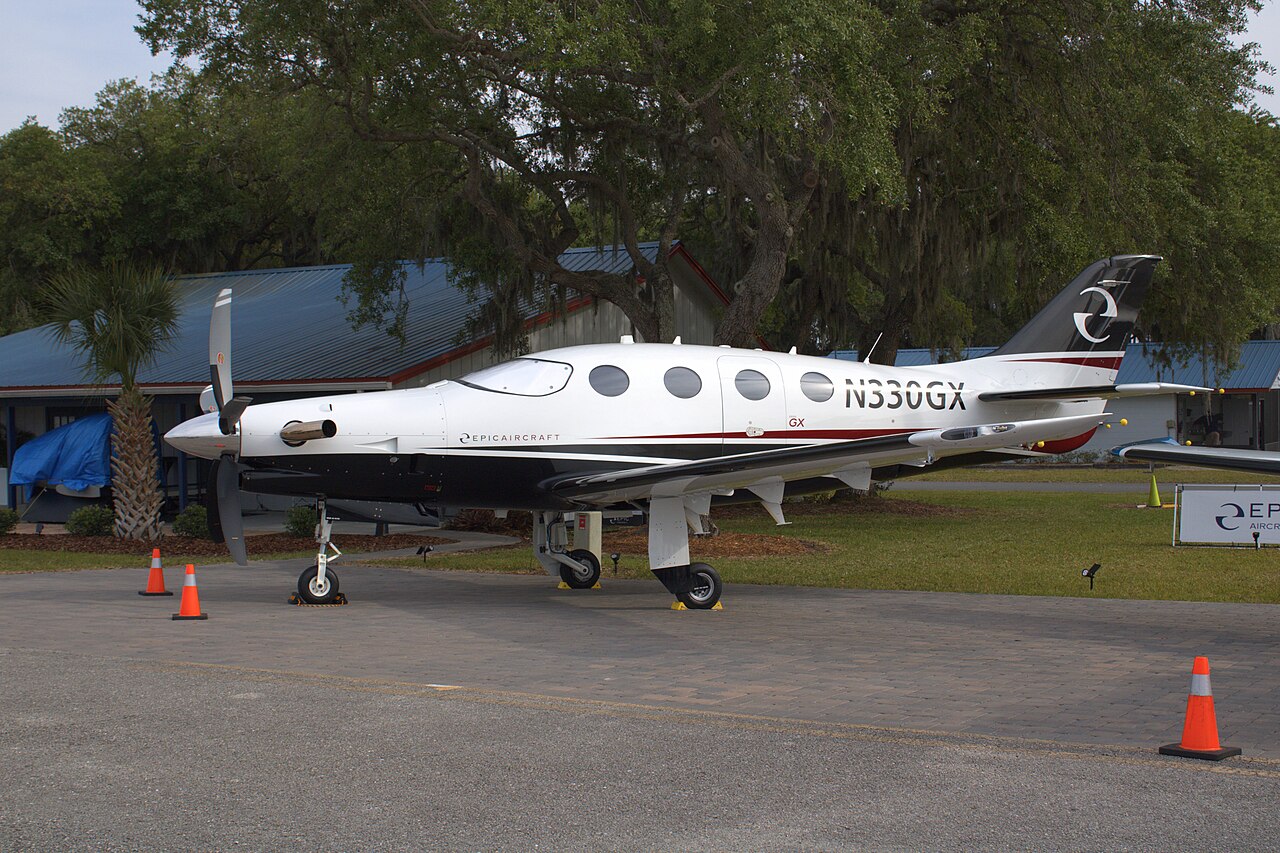
EPICThe Epic E1000 GX is a single-engine turboprop produced between 2019 and 2025. Price: the Epic E1000 GX is out of production and, used, the market median is around US$ 3.9M. Median from Jet Tracker's price research as of 06/2026. It has a range of 1560 nm, a cruise speed of 333 kt (617 km/h), 6 seats (pilot included). In Brazil there are 14 active units in the RAB-ANAC, excluding cancelled registrations. There are 20 aircraft from this family for sale today, across 26 listings on the portals Jet Tracker tracks (global market, not Brazil only).
Source: RAB-ANAC (data as of 11/10/2026) and Jet Tracker catalog (spec sheet reviewed on 11/9/2026).
Index ≈ ×1.09 to ×1.35 on the aircraft value, already with ferry, ANAC nationalization, IPI and ICMS.
Market estimate: value + ferry + ANAC nationalization + taxes, no legal review. II, PIS and COFINS are 0% for aircraft (NCM 88.02); IPI is 6.5% (3.25% for air taxi) until Dec 31, 2026; ~4% ICMS only through a qualified importer (Agreement 75/91).
Operate = direct cost/hour (fuel + maintenance + engine); excludes fixed costs (hangar, crew, insurance). World: hourly rate published by charter operators.
Median and price range for pre-owned aircraft, compiled by Jet Tracker from asking prices in listings and the price guides in the sources below, checked on 6/4/2026. 3 of 5 model years have an observed listing. The rest are estimates from the market curve between model years and are flagged in the chart.
PTAX · R$ 5.5765 / US$ · 11/10/2026
Market estimates for guidance only, not a firm quote. Confirm the value with a broker/appraiser before any transaction.
Epic E1000 GX, high-performance single-engine turboprop. 333 kt cruise, 6 passengers.
How much runway the Epic E1000 GX needs to dispatch: the manual figure and what the charter (RBAC 135) rule requires.
No mandatory factoring: fits 455 of 465 Brazilian public runways.
Verdict per regime (private, charter dry and wet) across 465 Brazilian public runways, with the margin in meters.
Starter feature. Available on your Jet Tracker account.
Manufacturer-published distances at sea level, ISA and reference weight. Not corrected for altitude, temperature, wind or runway condition, takeoff included. Uses the declared LDA as a proxy for effective runway length (RBAC 135.361) and the most favourable threshold in calm air (135.385(b)(1)): on the day, wind may force the shorter threshold. Destination only: does not assess the alternate aerodrome (135.387). Not a substitute for the AFM or the operator's performance analysis. Rule: RBAC 135.385 and 135.398; private flying (RBAC 91) is not factored. Runways: declared distance (LDA) from AISWEB/DECEA (2026-09-05), checkable on each aerodrome chart; where DECEA publishes no declared distance, physical length from OurAirports is used.
Typical factory configuration (curated data). The drawing below is schematic and at approximate scale; the actual layout varies by interior and year.
Detailed variants pending.
The E1000 program began in 2003 as a certified evolution of the experimental Epic LT kit, but faced two bankruptcy filings by Epic Aircraft (in 2009 and 2010) that nearly ended the project. After the acquisition by Engineering LLC (a Russian-Kazakh group) in 2012, development resumed and the FAA finally granted the type certificate in November 2019. In 2022 Epic launched the GX version with cabin improvements, updated G1000 NXi avionics and standard autothrottle.
With 1,200 SHP from the PT6A-67A and an all-composite fuselage with a swept wing, the E1000 reaches 333 kt true airspeed in cruise at FL340, surpassing the TBM 960 (330 kt) and the PC-12 NGX (290 kt). This brings it close to the entry-level jet frontier (Vision Jet 311 kt, HondaJet 422 kt) and allows 1,500+ nm missions in times comparable to small jets, with turboprop operations.
Unlike the TBM (conventional aluminum) and PC-12 (aluminum with composite sections), the E1000 has a fully composite fuselage. This allows keeping MTOW at 8,000 lb within the single-engine limit (no type rating) while delivering superior useful payload and a roomier cabin. It also reduces corrosion-related maintenance, a critical advantage for operators in coastal or humid tropical environments like Brazil.
The GX version brings autothrottle integrated with the Garmin GFC 700, a feature rare in single-engine turboprops and usually exclusive to jets. Combined with synthetic vision, ESP (Electronic Stability Protection) and envelope protection, the E1000 positions itself as the turboprop with the lowest single-pilot workload today, attracting owner-pilots moving up from high-performance piston aircraft or the Cirrus SR22T.
Despite the high performance, the E1000's cabin with 5 passenger seats, 18 cuft of baggage and a height of 1.42 m is significantly smaller than the PC-12 NGX's (up to 8 pax, a roomy cabin with a cargo door). For executive missions with large families or combined cargo, the PC-12 keeps the versatility advantage. The E1000 is optimized for owner-operators on high-speed missions with 4-5 pax.
The E1000 derives directly from the Epic LT, an experimental kit sold to amateur builders in the US since 2005, in the experimental category, with approximately 50 units built by owner-builders before Epic decided to pursue FAA certification of the Type Certificated version. Some characteristics of the Epic LT remain in the E1000 (cabin configuration, aerodynamic profile), but the structure, systems and avionics were completely redesigned to meet the Part 23 commuter category.
Listed aircraft with a page on Jet Tracker, from the lowest asking price up. Asking is not the closing price; portals and the reading date are on each page.
1 operational aircraft owned by companies in the ANAC registry (RAB), across the Epic E1000 GX family (2 variants). Each opens the profile with owner, operator, status and history.
The Epic E1000 GX is out of production, so there is no factory price. On the used market the median is around US$ 3.9M, varying with year and flight hours; see real listings on this model's Market tab. Reference value as of 06/2026.
The maximum range is 1560 nm (1,560 NM · 2,889 km).
Cruise speed is 333 kt, equivalent to 617 km/h.
The Epic E1000 GX has 6 seats in total, counting the pilot seat: up to 5 passengers.
There are 14 active units in the RAB-ANAC (data as of 11/10/2026): operational, mark reservation or suspended, excluding cancelled registrations.
3 distinct operators operate 14 units of the Epic E1000 GX in the RAB-ANAC: 14 in private operation (RBAC 91), concentrated in ES, SP and MT (data as of 11/10/2026). Name, fleet and state of each operator are on this model's Analytics tab and in the operators directory.
Jet Tracker estimate: about US$ 2,680 per flight hour at 200 h/year, of which US$ 1,220 per hour is variable cost (fuel, engine program, maintenance reserves) plus US$ 292,025 per year of fixed cost (crew, hangar, insurance), under Jet Tracker's default assumptions (Southeast Brazil, in-house crew, 200 h/year). Run your own scenario on this model's Costs tab.