Falcon 7XFalcon 8X2016+
RangeMTOWCruiseCeilingCabin volume
Key changes
Detailed variants pending.
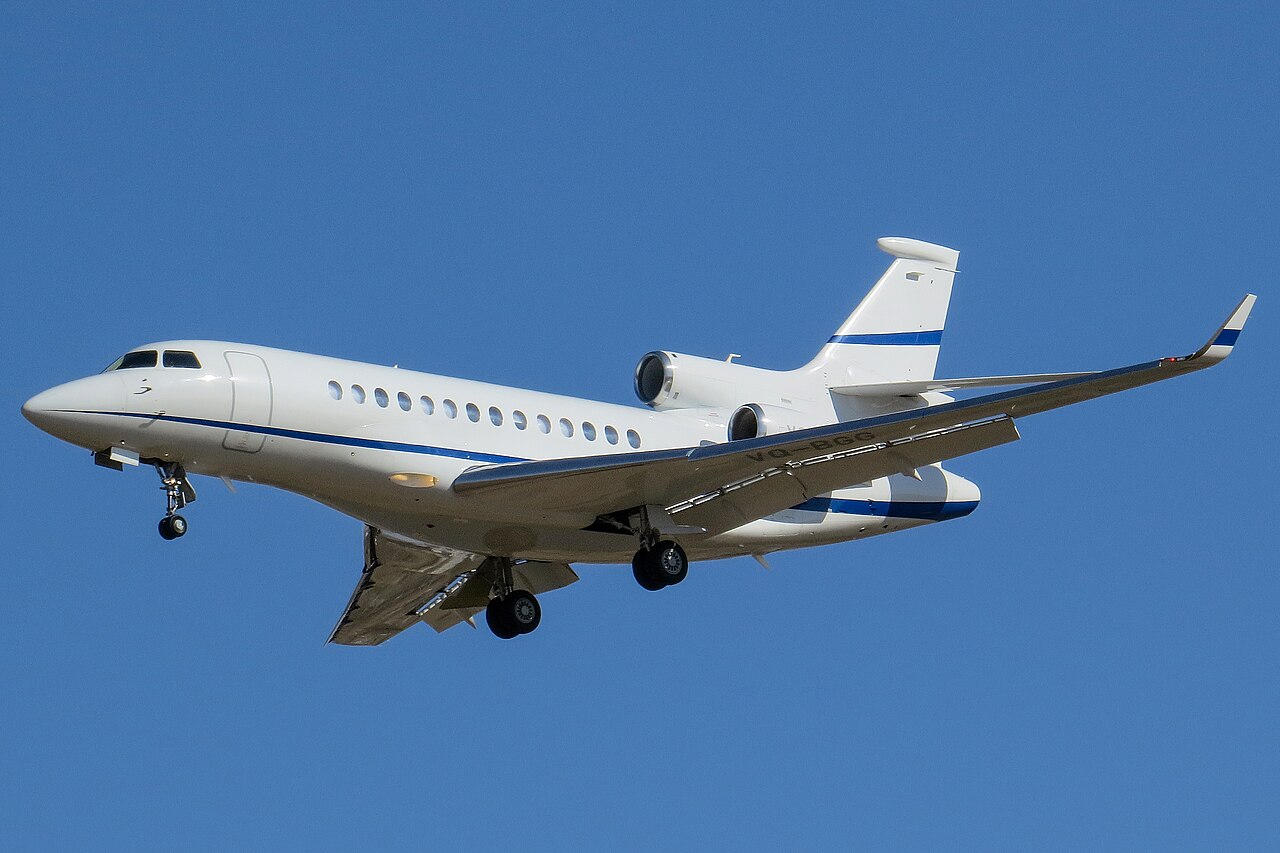
FA7XThe Dassault Falcon 7X is a large jet produced between 2007 and 2020. Price: the Dassault Falcon 7X is out of production and, used, the market median is around US$ 22.0M. Median from Jet Tracker's price research as of 06/2026. It has a range of 5950 nm, a cruise speed of 459 kt (850 km/h), Mach 0.90, up to 16 passengers. In Brazil there are 13 active units in the RAB-ANAC, excluding cancelled registrations. There are 65 aircraft from this family for sale today, across 102 listings on the portals Jet Tracker tracks (global market, not Brazil only).
Source: RAB-ANAC (data as of 11/9/2026) and Jet Tracker catalog (spec sheet reviewed on 11/8/2026).
Index ≈ ×1.08 to ×1.33 on the aircraft value, already with ferry, ANAC nationalization, IPI and ICMS.
Market estimate: value + ferry + ANAC nationalization + taxes, no legal review. II, PIS and COFINS are 0% for aircraft (NCM 88.02); IPI is 6.5% (3.25% for air taxi) until Dec 31, 2026; ~4% ICMS only through a qualified importer (Agreement 75/91).
Operate = direct cost/hour (fuel + maintenance + engine); excludes fixed costs (hangar, crew, insurance). World: hourly rate published by charter operators.
Median and price range for pre-owned aircraft, compiled by Jet Tracker from asking prices in listings and the price guides in the sources below, checked on 6/5/2026. 3 of 7 model years have an observed listing. The rest are estimates from the market curve between model years and are flagged in the chart.
PTAX · R$ 5.5127 / US$ · 11/09/2026
Market estimates for guidance only, not a firm quote. Confirm the value with a broker/appraiser before any transaction.
The Dassault Falcon 7X is a large category business jet, produced between 2007 and 2020 and identified by the ICAO code FA7X. It has a range of 5,950 nm, a cruise speed of 459 kt, and a service ceiling of 51,000 ft, with a maximum takeoff weight of 31,298 kg. The cabin has 12 seats in typical configuration and up to 16 seats. This page includes the technical specifications, the estimated operating cost, and the fleet registered in Brazil, with the evolution of registrations at ANAC.
How much runway the Falcon 7X needs to dispatch: the manual figure and what the charter (RBAC 135) rule requires.
Dispatches under charter rules at 105 of 465 Brazilian public runways when dry, and at 105 when wet.
Verdict per regime (private, charter dry and wet) across 465 Brazilian public runways, with the margin in meters.
Starter feature. Available on your Jet Tracker account.
Manufacturer-published distances at sea level, ISA and reference weight. Not corrected for altitude, temperature, wind or runway condition, takeoff included. Uses the declared LDA as a proxy for effective runway length (RBAC 135.361) and the most favourable threshold in calm air (135.385(b)(1)): on the day, wind may force the shorter threshold. Destination only: does not assess the alternate aerodrome (135.387). Not a substitute for the AFM or the operator's performance analysis. Rule: RBAC 135.385 and 135.398; private flying (RBAC 91) is not factored. Runways: declared distance (LDA) from AISWEB/DECEA (2026-09-05), checkable on each aerodrome chart; where DECEA publishes no declared distance, physical length from OurAirports is used.
Typical factory configuration (curated data). The drawing below is schematic and at approximate scale; the actual layout varies by interior and year.
Detailed variants pending.
Certified by EASA and the FAA in April 2007, the Falcon 7X became the world's first civil business jet with integrated triple-redundant digital fly-by-wire, technology inherited directly from the Rafale and the Mirage 2000. It revolutionized the large-cabin category: drag reduction of 1,500 lb in cruise, automatic envelope protection, smoother ride in turbulence and piloting workload comparable to a modern commercial wide-body.
After 9 years in production (2007-2016) and about 280 deliveries, the 7X was succeeded by the Falcon 8X, the same basic airframe with a fuselage stretched by 76 cm (10 cabin window plugs), updated PW307D engines and tanks extended to 6,450 nm. The 7X fleet in service continues with full Dassault support and EASy III + FalconEye upgrades available.
The Dassault Falcon 7X is a large business jet with a 5,950 nm range, built between 2007 and 2020. The up-to-date RAB-ANAC registration count is in the Brazil Fleet section of this page, and the breakdown by status (operational, registration-mark reservation, suspended) is in the model's Analytics.
According to the EASA type certificate data sheet (TCDS EASA.A.155, issue 17, of 23 Jul 2025), Dassault applied for certification on 26 May 2002 and received the EASA type certificate on 27 Apr 2007. The data sheet describes a long-range tri-jet with fly-by-wire flight controls and a maximum of 22 occupants, including a minimum crew of two. The three Pratt & Whitney Canada PW307A engines are rear-mounted, two on the sides of the fuselage and one in the center (PW307D on aircraft with modification M1000).
Out of production, the model can only be bought pre-owned. The pre-owned median and open listings, kept up to date, are in the price card and the For sale now card of this page.
Reviewed on 26/10/2026. Every number carries its source (manufacturer, certification authority or trade publication, with date); live fleet and market figures are in this page's sections.
Full analysis: listing, mark reservations, charts and change log in the ANAC Monitor.
The 7X's trijet configuration allows very high takeoff efficiency even in hot/high conditions; runways like Aspen, La Paz or Telluride become routine. The 3 PW307A engines combine 19,206 lbf of total thrust with competitive SFC. 5,950 nm covers Paris-Tokyo (5,500 nm), São Paulo-Lisbon (4,300 nm), Dubai-Sydney (6,300 nm with a favorable wind).
A cabin 11.91 m long by 2.34 m wide allows a layout of 3 distinct zones: forward club + mid four-place dining + aft divan/bedroom. 10.4 psi pressurization keeps the cabin at 6,000 ft at FL410, one of the best in the industry, reducing fatigue on transcontinental flights. Dassault premium forward galley with oven, microwave and wine chiller.
The overhaul cost of 3 PW307A engines (~USD 3.3M total every 6,000h) is significantly higher than for competing twin-jets: the Global 6000 (BR710 twin) or Gulfstream G550 (BR710 twin) come to ~USD 2.2M in the same window. A trade-off offset by the hot/high and short-field profile, but it weighs on DOC for charter operators.
Despite the MTOW of 31,298 kg, the Falcon 7X operates from runways of just 5,710 ft (1,741 m), an advantage of the trijet with generous takeoff thrust. It allows access to restricted London City (4,948 ft, but the 7X needs to derate), Aspen (8,000 ft elevation), São Paulo Congonhas and private airfields that the Gulfstream G650 and Global 6000 cannot use with full payload.
In 2016, Dassault launched FalconEye on the 7X (and standard on the 8X), the first civil Combined Vision System (CVS) that overlays Synthetic Vision (database) with Enhanced Vision (infrared camera) on a single HUD. It allows landings in reduced visibility conditions (CAT II equivalent) without ground equipment. Retrofit available for the existing 7X fleet for approximately USD 1.2M.
Listed aircraft with a page on Jet Tracker, from the lowest asking price up. Asking is not the closing price; portals and the reading date are on each page.
8 operational aircraft owned by companies in the ANAC registry (RAB), across the Falcon 7X family (2 variants). Each opens the profile with owner, operator, status and history.
The Dassault Falcon 7X is out of production, so there is no factory price. On the used market the median is around US$ 22.0M, varying with year and flight hours; see real listings on this model's Market tab. Reference value as of 06/2026.
The maximum range is 5950 nm (5,950 NM · 11,019 km).
Cruise speed is 459 kt, equivalent to 850 km/h, or Mach 0.90.
The Dassault Falcon 7X seats up to 16 passengers, crew not included.
There are 13 active units in the RAB-ANAC (data as of 11/9/2026): operational, mark reservation or suspended, excluding cancelled registrations.
10 distinct operators operate 10 units of the Dassault Falcon 7X in the RAB-ANAC: 10 in private operation (RBAC 91), concentrated in SP, CE and MG (data as of 11/9/2026). Another 3 units are under registration reservation (tail number reserved, not yet operating). Name, fleet and state of each operator are on this model's Analytics tab and in the operators directory.
Jet Tracker estimate: about US$ 11,505 per flight hour at 200 h/year, of which US$ 6,072 per hour is variable cost (fuel, engine program, maintenance reserves) plus US$ 1,086,600 per year of fixed cost (crew, hangar, insurance), under Jet Tracker's default assumptions (Southeast Brazil, in-house crew, 200 h/year). Run your own scenario on this model's Costs tab.
The Dassault Falcon 7X is a large business jet with a 5,950 nm range, built between 2007 and 2020. The up-to-date RAB-ANAC registration count is in the Brazil Fleet section of this page, and the breakdown by status (operational, registration-mark reservation, suspended) is in the model's Analytics.