Cirrus Vision Jet: the world's only single-engine jet is now ANAC-certified
The SF50 was already flying in Brazil, nationalized one aircraft at a time. Now it has ANAC's type stamp, and that changes the game for sales, support and financing.
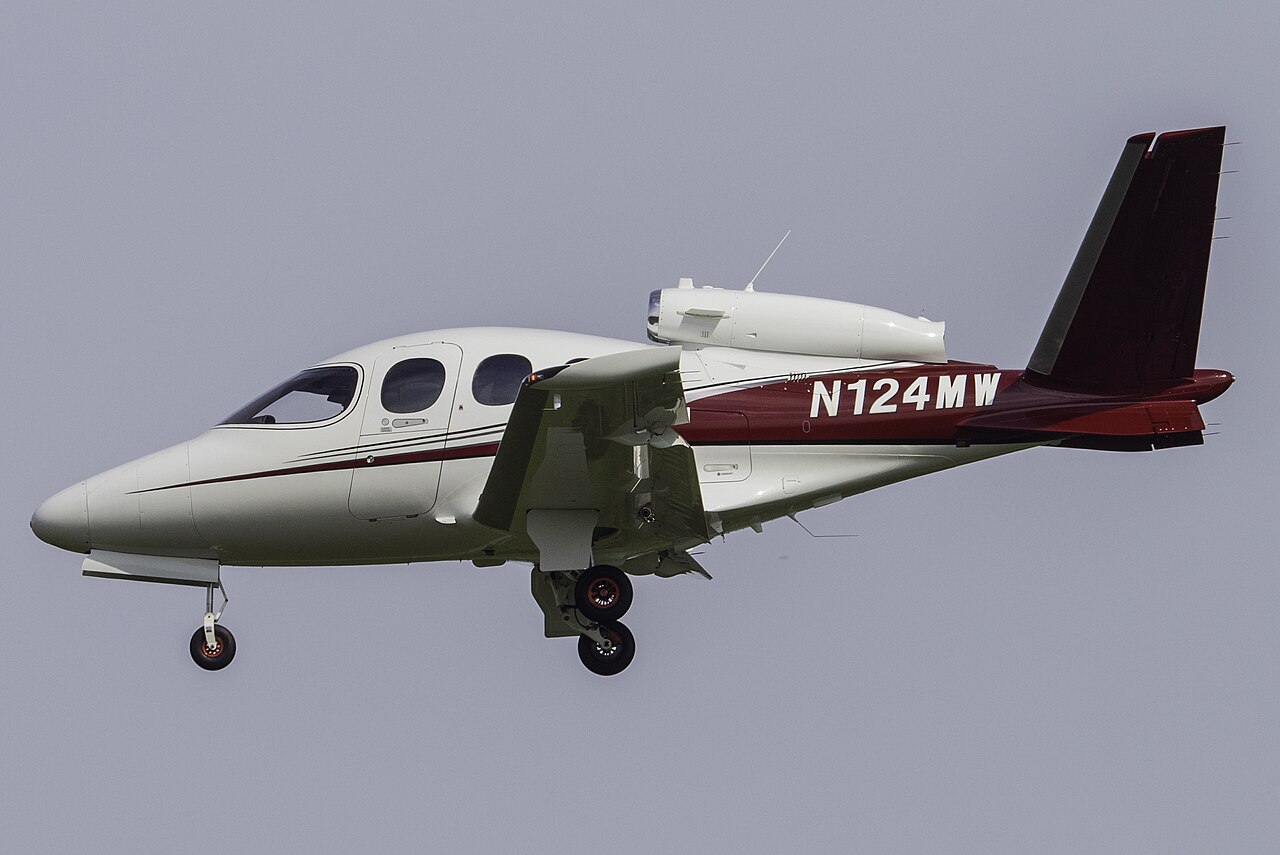
A 621-meter runway barely fits two city blocks. It is enough for the SF50 to take off: a single engine mounted on top of the fuselage, and a parachute folded under the cabin ceiling, ready to lower the entire aircraft in an emergency. This is not a trade-show concept. Since 2016 it has been a certified product in the United States, with more than 500 units delivered, and in August 2026 it got the stamp it was missing to officially enter the Brazilian market.
On August 6, 2026, Cirrus Aircraft announced that ANAC, Brazil's civil aviation authority, granted type certification to the Vision Jet G3, clearing it for sale and regular operation in Brazil. It is the world's only single-engine production jet, with the CAPS ballistic parachute system, and it arrives in a market that informally already knew the model.
What ANAC stamped
Type certification is different from individual registration. An imported aircraft can reach the RAB, Brazil's civil aircraft registry, through the case-by-case route, with specific validation; type certification is the broad endorsement, granted to the manufacturer, that authorizes factory sales, an official support network and structured financing in the country. It is that second door that Cirrus unlocked in August: the model can now be sold, delivered and maintained in Brazil through the manufacturer's standard channel, no longer only through the informal import route.
The aircraft's own timeline helps explain what is being certified now. The Vision SF50 received its first FAA type certificate in October 2016, after a development that began in 2006 and had a first flight in 2008, one of the longest cycles in modern business aviation. In 2019 came the G2, with more payload capacity; in 2022, the G2+, with Safe Return Autoland; the current generation, with renewed Garmin Perspective Touch+ avionics, is the one that received the Brazilian stamp (source: Cirrus Aircraft, model history, 2026).
The only jet in the world with a single engine
Every competitor in the light jet category (Citation, Phenom, HondaJet) uses two engines. The SF50 uses one, the Williams International FJ33-5A, mounted above the fuselage, with 1,846 lbf of thrust. It is a real exception in an industry where twin engines have always been the rule, and the architecture changes performance: a certified ceiling of 31,000 feet (against 41,000 to 45,000 feet for most light jets) and a cruise of 305 knots, slower than the HondaJet (422 knots) or the Phenom 100 (370 knots). On a 1,000 nm mission, the flight-time difference against twin competitors is more than an hour (source: FAA, Type Certificate Data Sheet A00018CH, Rev. 4; Jet Tracker catalog).
Twin engines exist for the case of a failure. The SF50 solves the same problem another way: a parachute the size of the aircraft.
In exchange, the balanced field length of 2,036 feet is one of the shortest among all jets in production, and the 1,275 nm range covers most Brazilian domestic legs. It is a jet designed for short runways and one-to-two hour trips, not for crossing continents.
The parachute that replaces the second engine
CAPS (Cirrus Airframe Parachute System) was not born on the SF50: it is a direct inheritance from the SR20/SR22 family, where Cirrus credits the system with more than 250 lives saved (source: Cirrus Aircraft, cited in the model history, 2026). On the jet, the same ballistic parachute can be deployed in an emergency to lower the entire aircraft under canopy, with all occupants. By 2024, the system had been deployed at least four times on Vision Jet units, with the occupants surviving in situations that would normally be fatal (source: Cirrus Aircraft/GAMA, 2024).
From the G2+ on, Safe Return Autoland came into play: any passenger can press a button on the cabin ceiling and the aircraft picks the nearest airport on its own, communicates with air traffic control, navigates there and lands with no human intervention, a feature designed for sudden pilot incapacitation. It is rare technology in business aviation: today only Cirrus, Daher (TBM) and Piper (M600) offer this kind of emergency automatic landing (source: Cirrus Aircraft, Vision Jet specifications, 2026).
What it costs to get into this jet
| Item | Value | Source and date |
|---|---|---|
| Factory price, G3 equipped | $3.46 million | Aviation Week, B&CA Purchase Planning Handbook, Mar 2026 |
| Used, global range | $1.9M to $4.0M | Jet Tracker listings curation, 2026 |
| Used in Brazil (2019 G2, nationalized) | listed at $3.1 million | AircraftExchange, Jun 2026 |
| All-in operating cost (450 h/yr) | ~$1,541/hour | Jet Tracker, cost curation (planephd.com, Conklin & de Decker), 2026 |
| Balanced takeoff field length | 2,036 ft (621 m) | FAA TCDS A00018CH Rev. 4 |
The full math, with adjustable assumptions for flight hours, hangar and crew, is on the Vision Jet page in the Jet Tracker catalog. The hourly cost is close to that of a top-of-the-line turboprop, but with a jet cabin and speed: that is the model's central proposition since launch, and the reason it is labeled a personal jet, a category of its own between the top-end turboprop and the traditional light jet.
Brazil already had Vision Jets before the stamp
The August certification does not inaugurate the model in the country, it formalizes a market that already existed. At least one unit has operated with a Brazilian registration since before the announcement: a 2019 G2, nationalized, with CAPS, weather radar and synthetic vision as standard, traded by a Brazilian brokerage in partnership with an American one. Three other units (a 2019 G2 and two G2+ from 2021 and 2022) appear for sale on national portals, all with price on request (source: Jet Tracker market curation, Jun 2026).
Who buys a single-engine jet
The SF50 is certified for single-pilot operation, without the costly type-specific training that traditional twin jets require. That changes the buyer profile: worldwide, the typical base migrates from top-end turboprops like the TBM or Pilatus PC-12, or comes straight from Cirrus's own SR22 family, looking for jet speed and ceiling without giving up the routine of flying alone. It is an aircraft designed for personal and family missions of one to two hours, with modest baggage space (30 cubic feet) and a cabin without an enclosed lavatory, details that move it away from full-service executive charter and closer to an owner-flown aircraft (source: Cirrus Aircraft, Vision Jet specifications, 2026).
It is this combination, the single engine and the parachute, that sets the Vision Jet apart from everything else in the Jet Tracker catalog. For anyone who wants to compare specification by specification against a turboprop or a traditional VLJ, the path is the site's model comparison tool.
What changes from here
With type certification, Cirrus can sell, deliver and support the Vision Jet in Brazil through the manufacturer's standard channel, something no individually nationalized unit had until now. That usually unlocks structured financing, factory warranty and original parts with predictable lead times, the three factors that weigh most in the decision to buy a business jet (see the step-by-step buying guide).
For anyone following the sector, the next signal to watch is the RAB: every new SF50 registration, and each registration reservation tied to the model, enters Jet Tracker analytics as soon as the registry is updated. It is the same mechanism that already shows the queue of registration reservations for other models before any aircraft operates.
Get the radar every Friday
New listings, price drops and probable sales of the week, straight to your inbox. Free.
Did this article help? Like it and send it to whoever flies, buys or sells in this market.
Frequently asked questions
Could the Cirrus Vision Jet already fly in Brazil before ANAC certification?
Yes, on a small scale. A few units reached the country through individual, case-by-case nationalization, and already operate with Brazilian registrations. The type certification granted in August 2026 is different: it opens the factory sales channel, official technical support and structured financing, which the individual route did not offer.
How much does a Cirrus Vision Jet cost?
A new, equipped Vision Jet G3 sells for about $3.46 million (Aviation Week, B&CA Purchase Planning Handbook, Mar 2026). On the used market, the global range is between $1.9 million and $4.0 million, depending on year and hours. The all-in operating cost, adding fuel, maintenance, insurance, crew and hangar, is close to $1,541 per hour at a utilization of 450 hours a year.
Is the Vision Jet safe as the only jet with a single engine?
The single-engine architecture is offset by the CAPS system, a ballistic parachute that lowers the whole aircraft in an emergency, inherited from the Cirrus SR20/SR22 family. From the G2+ on, the aircraft also gained Safe Return Autoland, which lands the aircraft on its own in case of pilot incapacitation.
What is the difference between the G2, the G2+ and the current Vision Jet generation?
The SF50 received FAA type certification in 2016. The 2019 G2 brought more payload capacity. The 2022 G2+ added Safe Return Autoland. The newest generation, now certified by ANAC, brings updated Garmin Perspective Touch+ avionics.
Where can you track the Vision Jets registered in Brazil?
The model page in the Jet Tracker catalog brings together specs, operating cost and the market of active listings, and the analytics shows registrations and registration reservations as soon as the RAB is updated.
Sources
- Cirrus Aircraft, ANAC certification of the Vision Jet G3
- AeroIn, Cirrus obtains ANAC certification for the G3 Vision Jet single-engine jet
- FAA, Type Certificate Data Sheet A00018CH, Rev. 4 (Cirrus SF50)
- Jet Tracker, model catalog and aircraft-for-sale market