Global ExpressGlobal 50002005–2019
RangeMTOWCruiseCeilingCabin volume
Key changes
Detailed variants pending.
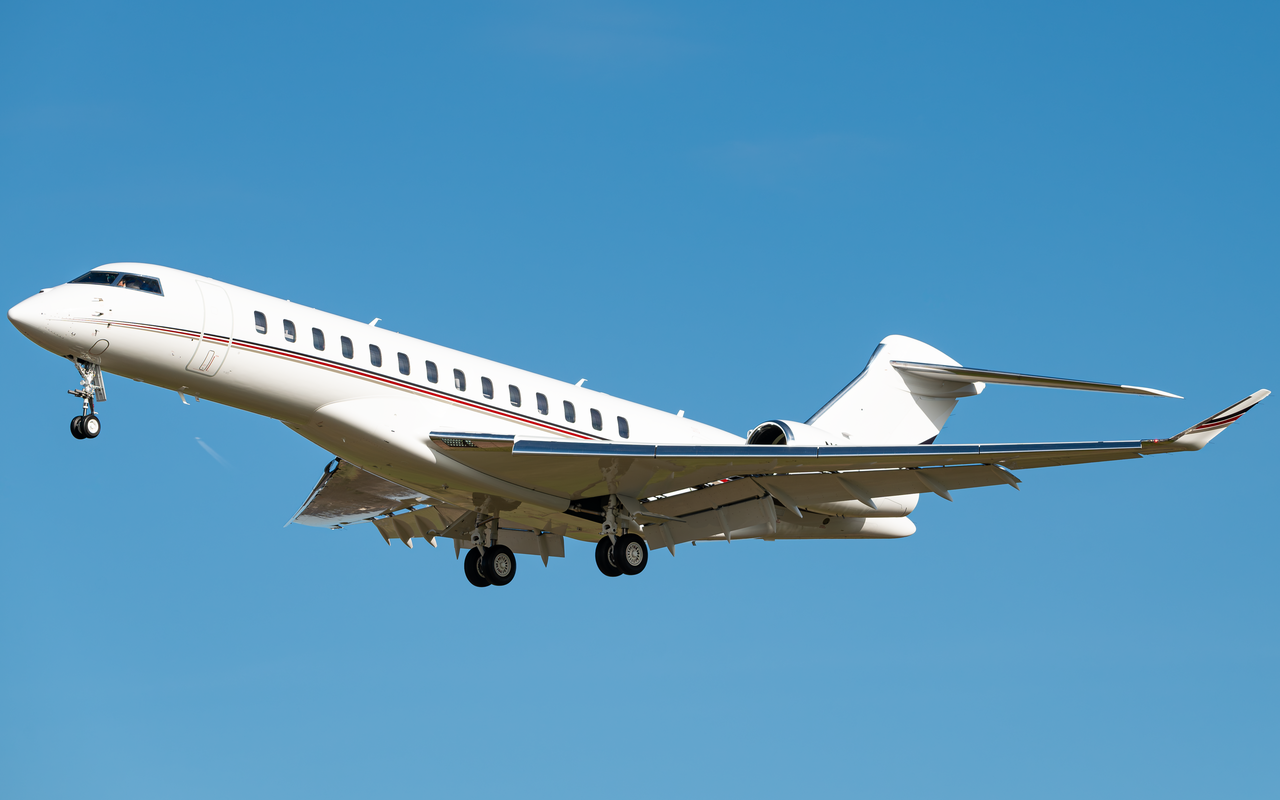
GL8TThe Bombardier Global 8000 is an ultra long range jet in production since 2025. Price: a new Bombardier Global 8000 starts at US$ 85.0M; used, the market median is around US$ 81.0M. Median from Jet Tracker's price research as of 06/2026. It has a range of 8000 nm, a cruise speed of 488 kt (904 km/h), Mach 0.95, up to 19 passengers. In Brazil the Global 5000 family (8 variants) has 30 active units in the RAB-ANAC, excluding cancelled registrations. There are 138 aircraft from this family for sale today, across 197 listings on the portals Jet Tracker tracks (global market, not Brazil only).
Source: RAB-ANAC (data as of 11/9/2026) and Jet Tracker catalog (spec sheet reviewed on 11/7/2026).
Index ≈ ×1.08 to ×1.32 on the aircraft value, already with ferry, ANAC nationalization, IPI and ICMS.
Market estimate: value + ferry + ANAC nationalization + taxes, no legal review. II, PIS and COFINS are 0% for aircraft (NCM 88.02); IPI is 6.5% (3.25% for air taxi) until Dec 31, 2026; ~4% ICMS only through a qualified importer (Agreement 75/91).
Operate = direct cost/hour (fuel + maintenance + engine); excludes fixed costs (hangar, crew, insurance). World: hourly rate published by charter operators. Brazil: charter is quoted per leg, so the hourly figure is an estimate from route quotes.
Median and price range for pre-owned aircraft, compiled by Jet Tracker from asking prices in listings and the price guides in the sources below, checked on 6/4/2026. 2 of 2 model years have an observed listing. The rest are estimates from the market curve between model years and are flagged in the chart.
PTAX · R$ 5.5127 / US$ · 11/09/2026
Market estimates for guidance only, not a firm quote. Confirm the value with a broker/appraiser before any transaction.
The Bombardier Global 8000 is a business jet in the ultra long range category, with production starting in 2025. It has a range of 8,000 nm, a cruise speed of 488 kt, and a service ceiling of 51,000 ft, with a maximum takeoff weight of 52,163 kg. The cabin has 17 seats in typical configuration and up to 19 seats. This page includes the technical specifications, the estimated operating cost, and the fleet registered in Brazil, with the evolution of registrations at ANAC.
How much runway the Global 8000 needs to dispatch: the manual figure and what the charter (RBAC 135) rule requires.
Dispatches under charter rules at 101 of 465 Brazilian public runways when dry, and at 101 when wet.
Verdict per regime (private, charter dry and wet) across 465 Brazilian public runways, with the margin in meters.
Starter feature. Available on your Jet Tracker account.
Manufacturer-published distances at sea level, ISA and reference weight. Not corrected for altitude, temperature, wind or runway condition, takeoff included. Uses the declared LDA as a proxy for effective runway length (RBAC 135.361) and the most favourable threshold in calm air (135.385(b)(1)): on the day, wind may force the shorter threshold. Destination only: does not assess the alternate aerodrome (135.387). Not a substitute for the AFM or the operator's performance analysis. Rule: RBAC 135.385 and 135.398; private flying (RBAC 91) is not factored. Runways: declared distance (LDA) from AISWEB/DECEA (2026-09-05), checkable on each aerodrome chart; where DECEA publishes no declared distance, physical length from OurAirports is used.
Typical factory configuration (curated data). The drawing below is schematic and at approximate scale; the actual layout varies by interior and year.
Detailed variants pending.
Detailed variants pending.
Detailed variants pending.
Detailed variants pending.
Detailed variants pending.
Detailed variants pending.
Detailed variants pending.
Announced at EBACE 2022 and certified in 2025, the Global 8000 establishes itself as the fastest civil jet currently in production; its Mmo of Mach 0.94 matches and surpasses the historic record of the Cessna Citation X+ (Mach 0.935, certified 2014). It is the first time in more than 10 years that a new model retakes the speed king title in business aviation. Validation was carried out with a test flight in May 2021 in which a modified Global 7500 reached Mach 1.015 in a controlled descent, demonstrating a safe margin for the envelope.
Program officially announced at EBACE 2022 (Geneva, May) with an original entry-into-service target of 2025, met within the window. First test flights of the conformity prototype in 2024, simultaneous Transport Canada and FAA certification in the 2nd half of 2025. Reported backlog of 80+ units in 2026, with NetJets, VistaJet and state VVIP operators as launch customers. Production line in Toronto (Downsview) shared with the Global 7500, expanded production efficiency.
The Bombardier Global 8000 is an ultra-long-range jet with an 8,000 nm range and up to 19 passengers, in production since 2025. On 22 Oct 2026, the RAB-ANAC registry did not separate the Global 8000 from the Global 7500, registered under the same type (BD-700-2A12). The up-to-date RAB-ANAC registration count, summed across the variants of the Global 5000 family, is in the Brazil Fleet section of this page, and the breakdown by status is in the model's Analytics.
Bombardier received the Transport Canada type certificate on 5 Nov 2025 and celebrated entry into service on 8 Dec 2025, when FAA and EASA certifications were still pending. In that release, Bombardier described the Global 8000 as the fastest civil aircraft since the Concorde, with a top speed of Mach 0.95, and with the lowest cabin altitude in business aviation production: 2,691 ft while flying at 41,000 ft.
New, the Global 8000 costs US$85.0 million typically equipped (B&CA Purchase Planning Handbook, Q1 2026). Open listings, kept up to date, are in the For sale now card of this page.
Reviewed on 26/10/2026. Every number carries its source (manufacturer, certification authority or trade publication, with date); live fleet and market figures are in this page's sections.
Full analysis: listing, mark reservations, charts and change log in the ANAC Monitor.
8,000 nm at Mach 0.85 covers Sydney-London (10,560 nm marginal but possible with tailwind), Hong Kong-NYC (8,060 nm), Dubai-Sydney (6,890 nm), Singapore-Buenos Aires (9,200 nm with tailwind). Tanks enlarged by an additional 2,000 lb (51,850 lb total) and small aerodynamic refinements (optimized winglets, fairings) delivered 300 extra nm vs. the Global 7500 with no significant MTOW change. Handles 13 hours non-stop with 8 passengers and baggage.
Keeps the proven cabin layout of the Global 7500, 4 distinct zones (Club Suite + Conference/Dining + Principal Suite with queen bed + dedicated Crew Rest area), cabin length 16.46 m, height 1.91 m, width 2.44 m. It allows simultaneous environments: executive passengers in the fwd lounge, dining/meeting in the mid, the principal sleeping in the aft master, crew resting in the dedicated forward rest area, a differentiator on 13h+ missions.
The upgraded Passports deliver 18,920 lbf each (vs. 16,500 lbf on the Global 7500), 14% more total thrust (37,840 lbf). Combined with enlarged tanks, next-generation FADEC and aerodynamic cycle optimization, it allows sustained Mach 0.94 in cruise. SFC kept competitive (~545 GPH cruise), TBO of 7,500h and maintenance interval kept. A Service Bulletin upgrade is available for the existing Global 7500 fleet to partially migrate to Global 8000 spec.
In May 2021, during envelope validation for the future Global 8000 specification, a test Global 7500 reached Mach 1.015 in a controlled descent, the first time a civil business jet has broken the sound barrier in any maneuver. It demonstrated that the airframe has significant structural margin to sustain Mach 0.94 cruise without a service life penalty. Memorable marketing that differentiated Bombardier from Gulfstream and Dassault in the ULR race.
Strategic positioning: the Global 8000 competes directly with the Gulfstream G800 (8,000 nm, USD 80.4M equipped, Mach 0.925) and the Dassault Falcon 10X (7,500 nm, USD 75M, Mach 0.925). Bombardier differentiators: speed (Mach 0.94 > Mach 0.925 for the rivals), a 4-zone cabin validated by the market (successor to the 7500, which sold 200+), mature ProLine Fusion avionics. Trade-off: cabin 7 cm lower than the Falcon 10X (1.98 m) and 33 cm narrower than the 10X (2.77 m).
Listed aircraft with a page on Jet Tracker, from the lowest asking price up. Asking is not the closing price; portals and the reading date are on each page.
19 operational aircraft owned by companies in the ANAC registry (RAB), across the Global 5000 family (8 variants). Each opens the profile with owner, operator, status and history.
PP-BFBPP-FCCPP-LHGPP-VDRPR-BPTPR-DYBPR-MLJPR-VDRPS-APMPS-BCOPS-BIRPS-BJBPS-BTGPS-CFGPS-MAKPS-RGLPS-STPPS-UQNPT-CTA
A new Bombardier Global 8000 costs about US$ 85.0M equipped, per B&CA Purchase Planning Handbook Q1 2026 (Aviation Week). On the used market the value varies with year and flight hours; see real listings on this model's Market tab. Reference value as of 03/2026.
The maximum range is 8000 nm (8,000 NM · 14,816 km).
Cruise speed is 488 kt, equivalent to 904 km/h, or Mach 0.95.
The Bombardier Global 8000 seats up to 19 passengers, crew not included.
The Bombardier Global 8000 has no separate registration of its own in the RAB-ANAC: the registry matches the base model. The Global 5000 family (8 variants) totals 30 active units (data as of 11/9/2026).
25 distinct operators operate 25 units of the Global 5000 in the RAB-ANAC: 4 in air taxi (RBAC 135) and 21 in private operation (RBAC 91), concentrated in SP, SC and MS (data as of 11/9/2026). Another 5 units are under registration reservation (tail number reserved, not yet operating). Name, fleet and state of each operator are on this model's Analytics tab and in the operators directory.
Jet Tracker estimate: about US$ 15,890 per flight hour at 200 h/year, of which US$ 5,670 per hour is variable cost (fuel, engine program, maintenance reserves) plus US$ 2,044,000 per year of fixed cost (crew, hangar, insurance), under Jet Tracker's default assumptions (Southeast Brazil, in-house crew, 200 h/year). Run your own scenario on this model's Costs tab.
The Bombardier Global 8000 is an ultra-long-range jet with an 8,000 nm range and up to 19 passengers, in production since 2025. On 22 Oct 2026, the RAB-ANAC registry did not separate the Global 8000 from the Global 7500, registered under the same type (BD-700-2A12). The up-to-date RAB-ANAC registration count, summed across the variants of the Global 5000 family, is in the Brazil Fleet section of this page, and the breakdown by status is in the model's Analytics.